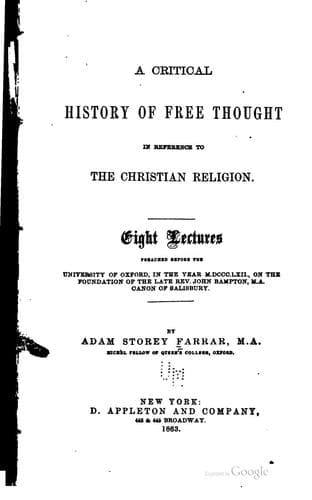
History of Free Thought in Reference to The Christian ReligionFarrar, Adam Storey
History
History of Free Thought in Reference to The Christian Religion
Farrar, Adam Storey
Free thought -- History
In pointing out his errors, we have hinted at their causes. The coldness
which scepticism and sensational philosophy(626) had induced in his mind,
which could kindle into warmth in describing the greatness either of men
or of events, but not in depicting the moral excellence of Christianity,
was but the reflection of the cold hatred of religious enthusiasm common
in his day. Nor would the historic views of primitive Christianity
commonly entertained in his time tend to dissipate his error. For it was
usual in that age of evidences to regard the early converts as cold and
cautious inquirers, accustomed to weigh evidences and suggest doubts. In
attempting to discover the doctrines and discipline of the English church
in apostolic times, there was a danger of transferring the notions of
modern decorum to the marvellous outburst of enthusiastic piety and
supernatural mystery which attended the communication of the heaven-sent
message; and therefore it is some palliation for Gibbon that he too failed
to perceive that those were times of excitement, when new ideas fell on
untried minds and yearning hearts. And it is a remarkable proof of the
improved general conception which men now entertain of Christianity, that
no apprehension of danger is now felt from Gibbon’s views. The youngest
student has imbibed a religious spirit so much deeper, that he cannot fail
instinctively to perceive their insufficiency as an explanation of the
phenomena.(627)
One of our great poets has celebrated the two literary exiles of the Leman
lake.(628) But how different are our feelings in respect of them in
relation to this subject! Both were deists; but the one dedicated his life
to a crusade against Christianity, the other only insinuated a few slight
hints: the one derived his faults from himself, the other from his age:
the one, the type of subtlety, acted by his pen on the world political;
the other, the type of industry, sought to instruct the student. The
writings of Voltaire remain as works of power, but not of information:
Gibbon’s history will endure as long as the English tongue.
Public-domain text, read in full here on John Shaqi.
Reviews
Reviews
No reviews yet
Be the first to share your thoughts on this work.
Elsewhere in the archive
Join the Discussion
Join the discussion
Sign in to leave a comment or review.
Sign InorCreate an account