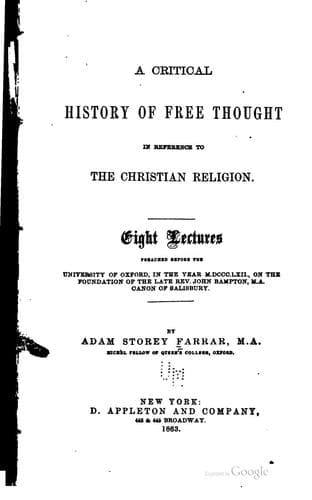
History of Free Thought in Reference to The Christian ReligionFarrar, Adam Storey
History
History of Free Thought in Reference to The Christian Religion
Farrar, Adam Storey
Free thought -- History
Paine is a character of a very different kind from the freethinker last
named.(629) Instead of the polished scholar, the polite man of letters,
and the historian, like Gibbon, we see in him an active man of the world,
educated by men rather than books, of low tastes and vulgar tone, the
apostle alike of political revolution and infidelity. Though a native of
England, his earliest life was spent in America at the time of the war of
independence. Returning to England with the strong feelings of liberty and
freedom which had marked the revolt of the colonies, he wrote at the time
of the outbreak of the French revolution a work called the Rights of Man,
in reply to Burke’s criticism on that event. Prosecuted for this work, he
fled to France, and was distinguished by being the only foreigner save
one(630) elected to the French Convention. During its session he composed
the infidel work called the Age of Reason, by which his name has gained an
unenviable notoriety; and after the alteration of political circumstances
in France, he returned to America, and there dragged out a miserable
existence, indebted in his last illness for acts of charity to disciples
of the very religion that he had opposed.
The two works, the Rights of Man, and the Age of Reason, being circulated
widely in England by the democratic societies of that period, contributed
probably more than any other books to stimulate revolutionary feeling in
politics and religion.(631) This popularity is owing partly to the
character of the language and ideas, partly to the state of public
feeling. Manifesting much plebeian simplicity of speech and earnestness of
conviction, they gave expression in coarse Saxon words to thoughts which
were then passing through many hearts. They were like the address of a
mob-orator in writing, and fell upon ground prepared. Political reforms
had been steadily resisted; and accordingly, when the success of foreign
revolution had raised men’s spirits to the highest point of impatience,
the middle classes, which wanted a moderate reform, were unfortunately
thrown on the side of the wild and anarchical spirits that wished for
utter revolution. The church, by holding with the state, was partly
involved in the same obloquy. Paine’s works, resembling Rousseau’s in
purpose, though quite opposite in style, were as much adapted to the lower
classes of England as his to the polished upper classes of France.
Public-domain text, read in full here on John Shaqi.
Reviews
Reviews
No reviews yet
Be the first to share your thoughts on this work.
Elsewhere in the archive
Join the Discussion
Join the discussion
Sign in to leave a comment or review.
Sign InorCreate an account