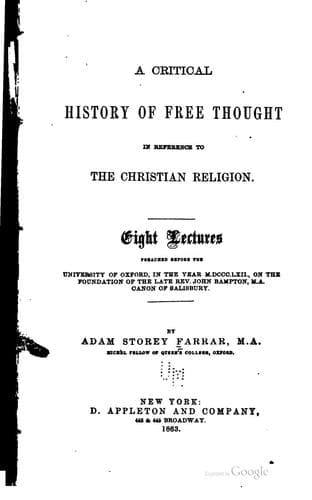
History of Free Thought in Reference to The Christian ReligionFarrar, Adam Storey
History
History of Free Thought in Reference to The Christian Religion
Farrar, Adam Storey
Free thought -- History
We have dwelt long on Shelley, as a most instructive example for observing
the various influences, personal and social, intellectual and moral,
philosophical and political, combining to form unbelief. His thoughts are
the last echo of the unbelief of the last century. The great movement of
Germany has completely changed the scepticism of the present. The
instances that we have found of unbelief in England were indications of a
tendency rather than a movement. They were however of sufficient
importance to call forth the voices of the church in reply or in protest.
It has been remarked, that in the former half of the eighteenth century
the attack was chiefly directed against the internal doctrines and
narratives of revelation, on the assumption that they clashed with the
judgment of common sense, or of the moral faculty. And therefore the
writers on the evidences, adapting their defence to the attack, employed
themselves chiefly in establishing the internal evidences, the moral need
of a revelation generally, and the suitability of the Christian in
particular, before producing the divine testimony which authenticates it.
But about the middle of this century the historic spirit arose, and the
point of attack shifted to an assault on the historic value of the
literature which contains the revelation. The question thenceforth became
a literary one, whether there was documentary proof that a revelation had
been given. The defence accordingly ceased to be philosophical, and became
historical.(649)
Public-domain text, read in full here on John Shaqi.
Reviews
Reviews
No reviews yet
Be the first to share your thoughts on this work.
Elsewhere in the archive
Join the Discussion
Join the discussion
Sign in to leave a comment or review.
Sign InorCreate an account