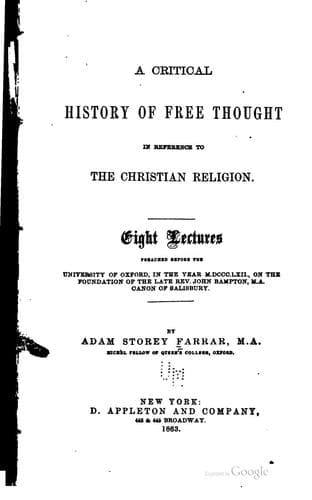
History of Free Thought in Reference to The Christian ReligionFarrar, Adam Storey
History
History of Free Thought in Reference to The Christian Religion
Farrar, Adam Storey
Free thought -- History
It has been well observed, that this tendency of the mind to personify
isolated qualities or impulses, was essentially the mythological
tendency(647) which had created the religion and expressed itself in the
poetry of the Greeks, and possibly contributed to foster Shelley’s
sympathies with heathen religion. His mind was peculiarly Greek, simple
not complex, imaginative rather than fanciful, abstract not concrete,
intellectual not emotional; wanting the many-sidedness of modern taste,
partaking of the unity of science rather than the multiformity of nature,
like sculpture rather than painting. This mental peculiarity contributed
to scepticism by inclining his mind to the pantheistic philosophy, which
can never be held save by those whose minds can give being to an
abstraction, and is revolting to those who are deeply touched with the
Hebrew consciousness of personality and of duty. His philosophy was at
first a form of naturalism, which identified God with nature, and made
body and spirit co-essential. In this stage he oscillated between the
belief of half personified self-moved atoms, or a general pervading spirit
of nature. From this stage he passed into a new one, by contact with the
philosophy of Hume; and, while admitting the diversity of matter and
spirit, yet denied the substantial reality of both. In this state of mind
he studied the philosophy of Plato, which was originally designed for
doubters somewhat analogous to him; and he readily imbibed the theory that
the passing phenomena are types of eternal archetypes, embodiments of
eternal realities. But it was Plato’s view of the universe that he
accepted, not his view of man; his metaphysics, not his ethics. In none of
these three theories is the rule of the universe ascribed to a character,
but in each to animated abstractions. They are a pantheistic or
mythological view of things.(648) Nor was the effect of this philosophy
merely theoretical, for the distorted view of the physical and moral
cosmos led him to believe that both should be regulated by the same
conditions; that men should have the unconstrained liberty which he
thought he saw in material things. Like Rousseau, ascribing moral evil to
the artificial laws of society, Shelley proposed to substitute a new order
of things, in which man should be emancipated from kings and priests. This
philosophy also increased his hatred against the moral order of the world,
and especially against Christianity; and led him to regard it as the
offshoot of superstition and the impediment to progress. Yet even here,
while echoing the irreverent doctrines of the French revolution, he bore
an unconscious witness to the majesty of the Christian virtues, in that he
could find no nobler type with which to invest his ideal race of men.
Public-domain text, read in full here on John Shaqi.
Reviews
Reviews
No reviews yet
Be the first to share your thoughts on this work.
Elsewhere in the archive
Join the Discussion
Join the discussion
Sign in to leave a comment or review.
Sign InorCreate an account