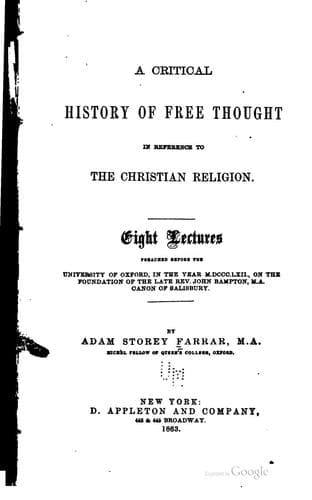
History of Free Thought in Reference to The Christian ReligionFarrar, Adam Storey
History
History of Free Thought in Reference to The Christian Religion
Farrar, Adam Storey
Free thought -- History
Abstract questions like this concerning the value of evidences find their
solution independently of the human will. The human mind cannot be
chained. New knowledge will suggest new doubts; and if so, spirit must be
combated by spirit. Defences of Christianity, attempts to readjust it to
new discoveries, must therefore continue to the end of time. In reference
to the minor question of the value of the historic evidences, it is
important to remember that these grand works are not simply refutative;
they are indirectly instructive and didactic. Just as miracles are a part
of Christianity, as well as evidences for its truth, so apologetic is a
lesson in Christianity, as well as a reply to doubt.(653) It happens also
that the most modern doubt of Germany has assumed the historic line, has
become critical instead of philosophical; and, though the criticism is
primarily of a different kind, it ultimately becomes capable of refutation
by the very line of argument used in the eighteenth century.(654) We
cherish therefore with devout reverence the memory of those writers who
employed the power of the pen to defend the religion that they loved. They
joined their intellectual labours to the spiritual earnestness which was
the other weapon for opposing unbelief. Providence blessed their work.
They sowed the seed of the intellectual and spiritual harvest which this
century is reaping. “And herein is that saying true, One soweth and
another reapeth. I sent you to reap that whereon ye bestowed no labour:
other men laboured, and ye are entered into their labours. And he that
reapeth receiveth wages, and gathereth fruit unto life eternal; that both
he that soweth and he that reapeth may rejoice together.”(655)
LECTURE VI. FREE THOUGHT IN THE THEOLOGY OF GERMANY FROM 1750-1835.
PHIL. iv. 8.
_Whatsoever things are true, whatsoever things are honest,
whatsoever things are just, whatsoever things are pure, whatsoever
things are lovely, whatsoever things are of good report; if there
be any virtue, and if there be any praise, think on these things._
Public-domain text, read in full here on John Shaqi.
Reviews
Reviews
No reviews yet
Be the first to share your thoughts on this work.
Elsewhere in the archive
Join the Discussion
Join the discussion
Sign in to leave a comment or review.
Sign InorCreate an account