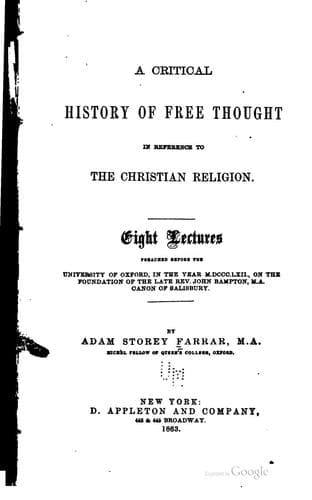
History of Free Thought in Reference to The Christian ReligionFarrar, Adam Storey
History
History of Free Thought in Reference to The Christian Religion
Farrar, Adam Storey
Free thought -- History
We are about to study the history of the movement in German theology,
which is usually described by the vague name of Rationalism,(656)—a
movement which, whether viewed specially in its relation to theology, or
to literature generally, must be regarded as one of the most memorable
efforts of human thought. It was one aspect of the great outburst of
mental activity in Germany, which within the last hundred years has
created a literature, which not only vies with the most renowned of those
which have added to the stock of human knowledge, but holds a foremost
rank among those which are characterised by originality and depth. The
permanent contribution made by it to the thought of the world is the
creation of a science of criticism,—a method of analysis, in which
philosophy and history are jointly employed in the investigation of every
branch of knowledge. If however it be viewed apart from the question of
utility, the works produced during this period, in poetry, speculation,
criticism, and theology, must ever make it memorable for monuments of
mental power, even when they shall have become obsolete as sources of
information.
The theological aspect of this great period of mental activity, which we
are about to sketch, has now probably so far assumed its final shape, and
given indications of the tendencies permanently created by it for good or
for evil, that it admits of being viewed as a whole, and its purpose and
meaning observed.(657)
We shall deviate slightly from the plan hitherto pursued, of selecting
only the sceptical form of free thought, and shall give an outline of
German theology generally; partly because the limits that sever orthodoxy
from heresy are a matter of dispute, partly in order that the movement may
be judged of as a whole. The size of the subject will preclude the
possibility of entering so fully into biographical notices of the writers,
or into the analysis of their writings, as in former lectures. We must
select such typical minds as will enable us to observe the chief
tendencies of thought.
As the stages of history are not arbitrarily severed, but grow out of each
other, we must briefly notice the mental conditions of the period in
Germany which preceded the rise of rationalism; next indicate the new
forces, the introduction of which was the means of generating the
movement; and then explain the movement itself in its chief phases and
present results.
Public-domain text, read in full here on John Shaqi.
Reviews
Reviews
No reviews yet
Be the first to share your thoughts on this work.
Elsewhere in the archive
Join the Discussion
Join the discussion
Sign in to leave a comment or review.
Sign InorCreate an account