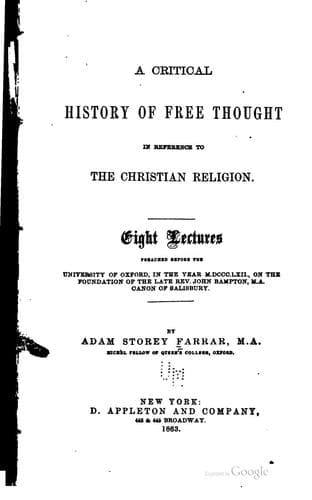
History of Free Thought in Reference to The Christian ReligionFarrar, Adam Storey
History
History of Free Thought in Reference to The Christian Religion
Farrar, Adam Storey
Free thought -- History
The exegetical method which formed the first was that which is now usually
called the old or common-sense rationalism.(721) This form of rationalism
differed from the English deism and French naturalism, in not regarding
the Bible as fabulous in character, and the device of priestcraft;(722)
but only denied the supernatural. By them the apostles had been regarded
as impostors; and scripture was not only not received as divine, but not
even respected as an ordinary historical record; whereas rationalism was
intended as a defence against this view. It denied only the revealed
character of scripture, and treated it as an ordinary history; and,
distinguishing broadly between the fact related and the judgment on the
fact, sought to separate the two, and explained away the supernatural
element, such as miracles, as being orientalisms in the narrative, adapted
to an infant age, which an enlightened age must translate into the
language of ordinary events.
Eichhorn at Göttingen(723) applied this view to the Old Testament. Deeming
miracles impossible, he did not regard them as fraud, but admitted on the
contrary that the agents or narrators honestly believed them. The
supernatural was not imparted to deceive, but was the result of oriental
modes of speech, such as hyperbole, parable, or ellipsis, in which the
steps by which the process was performed were omitted. The smoke of Sinai
was considered a thunderstorm; the shining of Moses’s face a natural
phenomenon.
The principles which Eichhorn applied to the Old Testament, Paulus of Jena
extended to the New.(724) The miraculous cures were explained by an
ellipsis in the omission of the natural remedies; the casting out of
devils as the power of a wise man over the insane; the transfiguration as
the confused recollection of sleeping men, who saw Jesus with two unknown
friends, in the beautiful light of the morning among the mountains: nay,
trespassing on still more holy ground, he dared impiously to explain away
the resurrection of our blessed Lord by the hypothesis that his death was
only apparent. These are a specimen of the mode of exegesis adopted in
this school, which is usually specifically called Rationalism. In this
mode Jesus appeared to be merely a wise and virtuous man; and his miracles
were merely acts of skill or accident. Paulus presented this as the
original Christianity. The theory did not last long, save in the mind of
its author, who lived until a recent period, to see the entire change of
critical belief. Attributing the supernatural to ignorance, it did not
even propose, like the later schools, to explain the marvellousness of the
phenomena, objectively by so plausible a theory as legends, nor
subjectively by myths:(725) it was too clumsy, not to say irreverent, an
explanation of the facts to satisfy a people of deep and poetical soul
like the Germans.
Public-domain text, read in full here on John Shaqi.
Reviews
Reviews
No reviews yet
Be the first to share your thoughts on this work.
Elsewhere in the archive
Join the Discussion
Join the discussion
Sign in to leave a comment or review.
Sign InorCreate an account