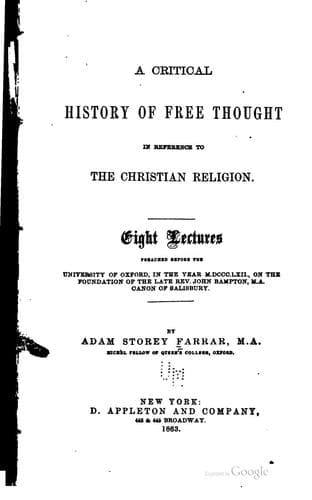
History of Free Thought in Reference to The Christian ReligionFarrar, Adam Storey
History
History of Free Thought in Reference to The Christian Religion
Farrar, Adam Storey
Free thought -- History
He detected, as he supposed, innate forms of thought(713) in the mental
structure, which form the conditions under which knowledge is possible.
When he applied his system to give a philosophy of ethics and religion, he
asserted nobly the law of duty written in the heart,(714) but identified
it with religion. Religious ideas were regarded as true regulatively, not
speculatively. Revelation was reunited with reason, by being resolved into
the natural religion of the heart. Accordingly, the moral effect of this
philosophy was to expel the French materialism and illuminism,(715) and to
give depth to the moral perceptions: its religious effect was to
strengthen the appeal to reason and the moral judgment as the test of
religious truth; to render miraculous communication of moral instruction
useless, if not absurd; and to reawaken the attempt, which had been laid
aside since the Wolffian philosophy, of endeavouring to find a philosophy
of religion.(716) From this time in German theology we shall find the
existence of the twofold movement; the critical one, the lawful descendant
of Semler, examining the historic revelation; and the philosophical one,
the offshoot of the system of Kant, seeking for a philosophy of religion.
During the next twenty years, from 1790 to 1810, when so many influences
were operating in common, it is not easy to measure the effect of the
speculative philosophy upon particular minds with such exactness as to
ascertain which ought properly to be classed in the destructive tendency,
and which gave signs of the reaction. We must however be careful to
exclude those younger minds(717) that were already appearing on the field,
to become the heroes of the subsequent history, whose tone was so
decidedly affected by new influences as to belong to the age of reaction.
In this sub-period we may name three tendencies: (1) the continuation of
the Exegesis inaugurated in the last epoch by Semler, until about the end
of the century it found its utmost limit in Paulus,(718)—the result of the
age of illumination; (2) a dogmatic tendency, more or less the growth of
new influences introduced by the new philosophy, which attempted to
reconcile reason with the supernatural, and may be represented in its
nearest approach to orthodoxy, at the end of this period, by
Bretschneider;(719) and (3) the awakening of a distinct expression of the
appeal to the supernatural which had never quite died out in the church,
in the Arminianism of Reinhardt in the north, and of Storr in the
south.(720) The last needs no further investigation; but we shall consider
briefly the other two.
Public-domain text, read in full here on John Shaqi.
Reviews
Reviews
No reviews yet
Be the first to share your thoughts on this work.
Elsewhere in the archive
Join the Discussion
Join the discussion
Sign in to leave a comment or review.
Sign InorCreate an account