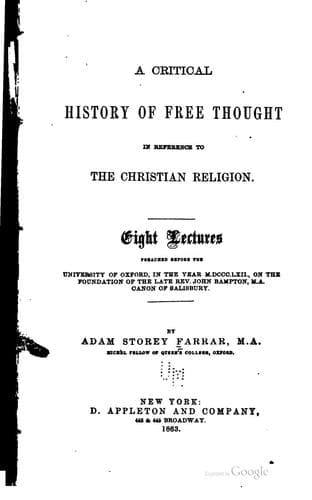
History of Free Thought in Reference to The Christian ReligionFarrar, Adam Storey
History
History of Free Thought in Reference to The Christian Religion
Farrar, Adam Storey
Free thought -- History
Before the conclusion of the last century, while still the literary
influence of Weimar was at its height, he wrote Discourses on
Religion,(759) to arouse the German mind to self-consciousness; which
produced as stirring an effect in religion(760) as Fichte’s patriotic
addresses to the German nation subsequently in politics; and from them may
be dated the first movement of spiritual renovation, as from the latter
the first of German liberation from foreign control. In successive works
his views on ethics and religion were gradually developed, until, in his
_Glaubenslehre_ (31) he produced one of the most important theological
systems ever conceived. We can give no idea of the compass exhibited in
that work, nor spare time to trace the growth in Schleiermacher’s own mind
as new influences like that of Harms, which he rejected, indirectly
influenced him; but we must be content to define his general position in
its destructive and constructive aspects.
The fundamental principles(761) were, that truth in theology was not to be
attained by reason, but by an insight, which he called the Christian
consciousness,(762) which we should call Christian experience; and that
piety consists in spiritual feeling, not in morality. Both were
corollaries from his philosophical principles.
There are two parts, both in the intellectual and emotional branches of
our nature;—in the emotional, a feeling of dependence in the presence of
the Infinite, which is the seat of religion; and a consciousness of power,
which is the source of action and seat of morality;—and in the
intellectual, a faith or intuition which apprehends God and truth; and
critical faculties, which act upon the matter presented and form
science.(763) In making these distinctions, Schleiermacher struck a blow
at the old rationalism, which had identified on the one hand religion and
morality, and on the other intuition and reason. Hence from this point of
view he was led to explain Christianity, when contrasted with other
religions, subjectively on the emotional side, as the most perfect state
of the feeling of dependence; and on the intellectual, as the intuition of
Christianity and Christ’s work: and the organ for truth in Christianity
was regarded to be the special form of insight which apprehends Christ,
just as natural intuition apprehends God; which insight was called the
Christian consciousness.(764) Thus far many will agree with him. Perhaps
no nobler analysis of the religious faculties has ever been given.
Religion was placed on a new basis: a home was found for it in the human
mind distinct from reason. The old rationalism was shown to be untrue in
its psychology. The distinctness of religion was asserted; and the
necessity of spiritual insight and of sympathy with Christian life
asserted to be as necessary for appreciating Christianity, as æsthetic
insight for art.
Public-domain text, read in full here on John Shaqi.
Reviews
Reviews
No reviews yet
Be the first to share your thoughts on this work.
Elsewhere in the archive
Join the Discussion
Join the discussion
Sign in to leave a comment or review.
Sign InorCreate an account