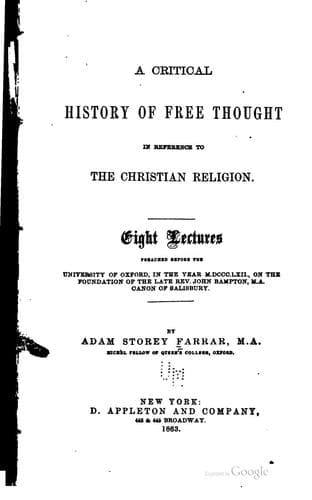
History of Free Thought in Reference to The Christian ReligionFarrar, Adam Storey
History
History of Free Thought in Reference to The Christian Religion
Farrar, Adam Storey
Free thought -- History
In its reconstruction of Christian truth, however, fewer will coincide.
Following out the same principles; in the same manner as he regarded the
intuitions of human nature to be the last appeal of truth in art or
morals, so he made the collective Christian consciousness the last
standard of appeal in Christianity. The dependence therefore on apostolic
teaching was not the appeal to an external authority, but merely to that
which was the best exponent of the early religious consciousness of
Christendom in its purest age.(765) The Christian church existed before
the Christian scriptures. The New Testament was written for believers,
appealing to their religious consciousness, not dictating to it.
Inspiration is not indeed thus reduced to genius, but to the religious
consciousness, and is different only in degree, and not in kind, from the
pious intuitions of saintly men. The Bible becomes the record of religious
truth, not its vehicle; a witness to the Christian consciousness of
apostolic times, not an external standard for all time. In this respect
Schleiermacher was not repeating the teaching of the reformation of the
sixteenth age, but was passing beyond it, and abandoning its reverence for
scripture.
From this point we may see how his views of doctrine as well as his
criticism of scripture were affected by this theory. For in his view of
fundamental doctrines, such as sin, and the redeeming work of Christ,
inasmuch as his appeal was made to the collective consciousness, those
aspects of doctrine only were regarded as important, or even real, which
were appropriated by the consciousness, or understood by it.(766) Sin was
accordingly presented rather as unholiness than as guilt before God;(767)
redemption, rather as sanctification than as justification; Christ’s death
as a mere subordinate act in his life of self-sacrifice, not the one
oblation for the world’s sin;(768) atonement regarded to be the setting
forth of the union of God with man; and the mode of arriving at a state of
salvation,(769) to be a realisation of the union of man with God, through
a kind of mystical conception of the brotherhood of Christ.(770)
Public-domain text, read in full here on John Shaqi.
Reviews
Reviews
No reviews yet
Be the first to share your thoughts on this work.
Elsewhere in the archive
Join the Discussion
Join the discussion
Sign in to leave a comment or review.
Sign InorCreate an account