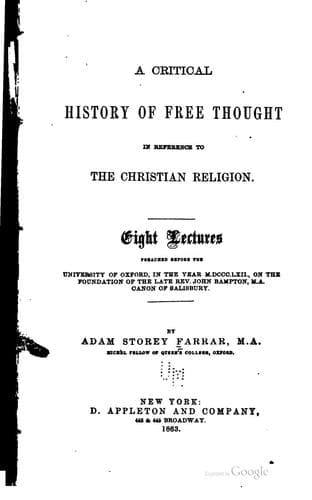
History of Free Thought in Reference to The Christian ReligionFarrar, Adam Storey
History
History of Free Thought in Reference to The Christian Religion
Farrar, Adam Storey
Free thought -- History
The method had many advantages, in displacing a low materialism, in
stimulating loftiness of conception, and generating an historic study of
every subject, by its view of the universe as a development; and also
created a largeness of sympathy with differing views, by regarding all
things as in transition, relative, true only in reference to their
contradictory; and by considering all hypotheses to contain a germ of
right, and to be the result of partial views of truth; but it will also be
obvious, that the method had its evil effects. For, when applied to any
department, it produced a disposition to seize the principle, the idea, of
which the concrete is the embodiment; to descend from the type upon the
individual. Its method was deductive and idealistic; giving being to
abstractions, like the realism of the middle ages. It lost the fact in the
principle; it personified the genus. Philosophy became a vast mythology.
When applied to Christianity, for example, it did not attempt to find a
philosophic ground for it psychologically in the human aspirations, as
Schleiermacher had done,(805) but objectively in the dogma. It discovered
the ideal truth in religion, and regarded Christianity and Christ as being
the manifestation of the effort of the great Spirit of the universe to
convert the idea into act; the symbol which expressed the speculative
truth of the essential unity of the ideal and the real, of the divine and
the human. Like the ancient Gnosticism, it believed in dogmatic
Christianity, because it descended upon it from an _á priori_ principle,
in which it found the explanation of it. Religion and philosophy were
reconciled, because religion was made a phase of philosophy.
Public-domain text, read in full here on John Shaqi.
Reviews
Reviews
No reviews yet
Be the first to share your thoughts on this work.
Elsewhere in the archive
Join the Discussion
Join the discussion
Sign in to leave a comment or review.
Sign InorCreate an account