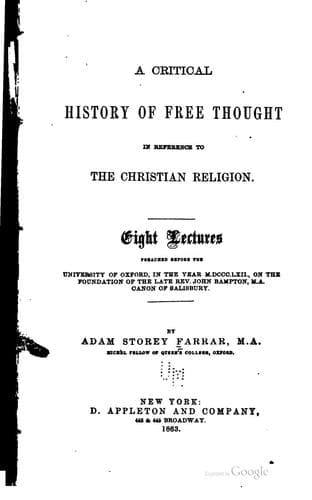
History of Free Thought in Reference to The Christian ReligionFarrar, Adam Storey
History
History of Free Thought in Reference to The Christian Religion
Farrar, Adam Storey
Free thought -- History
It was this school which gave origin to the subsequent movements in
Germany. The sudden alteration in German thought induced by Strauss, which
ushers in the modern period, arose from the union of the philosophical
principles of this school with the criticism of that of De Wette. We must
therefore endeavour to understand this movement, which forms the turning
point between the reaction before described, which is the second of the
three general divisions made of this portion of history,(802) and the
forms which succeed constituting the third division. Hegel,(803) a name
almost as important in its influence on the German mind as that of Goethe,
has been already mentioned(804) as the last of that band of philosophers
which strove to develop the mental as distinct from the material
principle, presented in Kant’s philosophy. Kant had completed the process
of turning man’s search inward, which Descartes had begun. Philosophy
became psychology; the discovery of the limits of knowledge, rather than
of the nature of the thing known. We have seen that Fichte and Schelling,
not content with this result, had sought, though by opposite processes, to
escape from this limited knowledge; to attain an ontology as well as a
psychology. All philosophy aims at attaining a knowledge of reality,
either _à posteriori_ by means of generalisation, or _à priori_ from the
data of mind. These two philosophers strove to attain it by the latter
mode; but their method either lacked system, or failed in its results:
their philosophy was poetry rather than logic. Hegel followed in their
steps, but adopted a basis which admitted of being developed in a formal
system. The logical rigour of his method, and the encyclopædic grasp which
it gave over knowledge, partly accounted, as in the case of Spinoza or of
Wolff, for its popularity. The universe was to be interpreted from the
mind; the laws of thought were the laws of things. The microcosm and the
macrocosm were one; thought, and the mind that thinks; or, more truly,
both were phases of the universal mind which was unfolding. The mind of
man could transcend the limits of the finite and phenomenal; and, being
able to apprehend the idea, the νοούμενον, absolutely, without condition,
thus possessed the solution of any branch of universal knowledge by an _à
priori_ process. The problem of philosophy was, to find the laws of this
evolution in thought, to catch the ideal when it strives to become
immanent and to manifest itself in the actual.
Without attempting here to explain the kind of threefold process, (35)
according to which this evolution takes place, it is better, as in the
case of the former philosophies named, to exhibit the influence of the
general method rather than the effects of particular theories inculcated
by it.
Public-domain text, read in full here on John Shaqi.
Reviews
Reviews
No reviews yet
Be the first to share your thoughts on this work.
Elsewhere in the archive
Join the Discussion
Join the discussion
Sign in to leave a comment or review.
Sign InorCreate an account