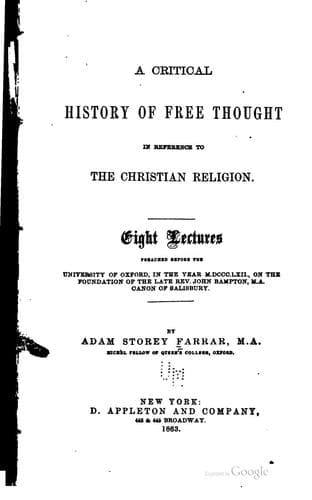
History of Free Thought in Reference to The Christian ReligionFarrar, Adam Storey
History
History of Free Thought in Reference to The Christian Religion
Farrar, Adam Storey
Free thought -- History
The leader of this school was Christian Baur, (39) lately deceased; a man
of large erudition; a wonder of acuteness even in Germany; distinguished
for the extraordinary ability displayed in his reply to the attacks made
on Protestantism by the celebrated Roman catholic theologian Moehler: and
though the doctrinal result of the school is ethics or pure Socinianism
and naturalism, and the critical opinions obviously are most extravagant,
the sagacity and learning shown in the monographs published by it make
them some of the most instructive, as sources of information, in modern
theology, to those who know how to use them aright. From an orthodox point
of view the effect of the school is most destructive; but, if viewed in
reference to the preceding schools, it manifests a tenacious hold over the
historic side of Christianity, and has affected in a literary way the
schools formerly described, which claim lineage from the older critics.
As the tendency just described is the modern representative of the older
critical schools; so the next holds a similar position to the
philosophical.
The school is frequently on this account described by the same name, of
“Mediation theology,”(841) originally applied to Schleiermacher, because
it attempts to unite science with faith, a true use of reason with a
belief in scripture. It comprises the chief theological names of Germany,
some of whom were disciples of Schleiermacher, others of the orthodox
portion of the Hegelian party. Their object is not simply, like the
revivers of Lutheran orthodoxy, to surrender the judgment to an external
authority in the church, nor to give unbounded liberty to it like the
critical school: not going back like the one to the ancient faith of the
church, nor progressing like the other to new discoveries in religion,
they seek to understand that which they believe, to find a philosophy for
religion and Christianity.
Two theologians stand out above the others, as evincing vitality of
thought, and boldly attempting to grapple with the philosophical
problems;—Dorner(842) and Rothe,(843) both very original, but bearing
traces of the influence of their predecessors. The former, moulded by the
Hegelian school, investigates the Christological problem which lies at the
basis of Christianity; the latter, moulded rather by the school of
Schleiermacher, has attempted the cosmological, which lies at the basis of
religion and providence.
Public-domain text, read in full here on John Shaqi.
Reviews
Reviews
No reviews yet
Be the first to share your thoughts on this work.
Elsewhere in the archive
Join the Discussion
Join the discussion
Sign in to leave a comment or review.
Sign InorCreate an account