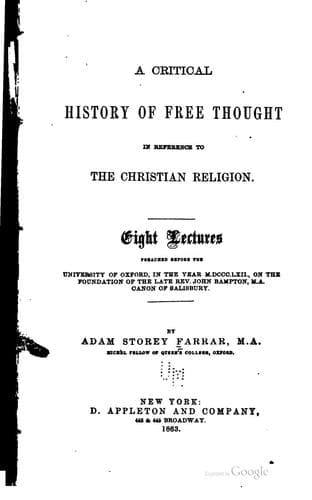
History of Free Thought in Reference to The Christian ReligionFarrar, Adam Storey
History
History of Free Thought in Reference to The Christian Religion
Farrar, Adam Storey
Free thought -- History
The work of Dorner on “the Person of Christ” formed an epoch in German
theology, by its fulness of learning, its orthodoxy of tone, and its union
of speculative powers with historic erudition. The Christian doctrine of
the incarnation is, that God and man have been united in an historic
person as the essential condition for effecting human salvation. If the
doctrine be viewed on the speculative side, the problem is to show _à
priori_ that this historic union ought to exist; if viewed on the
historic, to prove that it has existed as a fact. The great aim of the
Christology of the Hegelian system was to effect the former; the aim of
Strauss was to destroy the latter. Dorner strove to reconstruct the
doctrine, by making the historical study of its progress the means of
supplying the elements of information for doing so. He commences by an
examination of other religions,(844) in order at once to show the
existence in them of blind attempts to realise that truth which the
incarnation supplied, and to prove the impossibility that the Christian
doctrine can have been borrowed from human sources, as the critical and
mythical interpreters would assume. He discovers in all religions the
desire to unite man to God; but shows(845) that the Christian doctrine
cannot have been derived from the oriental, which humanised God; nor from
the Greek, which deified man; nor from the Hebrew in its Palestinian form,
which degraded the idea of the incarnate God into a temporal Messiah; nor
in its Alexandrian form, which never reached, in its theory of the Λόγος,
the idea of the distinction of person of the Son from the Father. Thus
establishing the originality of the idea in Christianity, and exhibiting
it as the fulfilment of the world’s yearnings, he traces it in the
teaching of the apostles, and of the apostolic age,(846) next as marking
the different heretical sects,(847) which respectively lost sight of one
of the two elements, till he finds the church’s explicit statement of the
doctrine in its fulness;(848) and then pursues it onwards through the
course of history to the present time.(849) Though the work is to an
English mind difficult, through the air of speculation which pervades it,
and perhaps open to exception in some of its positions; yet, viewed as a
whole, it is a magnificent argument in favour of Christianity; exhibiting
the incarnation as the satisfaction for the world’s wants, as the original
and independent treasure in Christianity; and showing the process through
which Providence in history has caused the doctrine to be evolved and
preserved.
Public-domain text, read in full here on John Shaqi.
Reviews
Reviews
No reviews yet
Be the first to share your thoughts on this work.
Elsewhere in the archive
Join the Discussion
Join the discussion
Sign in to leave a comment or review.
Sign InorCreate an account