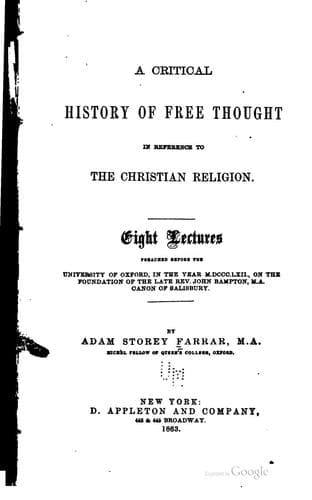
History of Free Thought in Reference to The Christian Religion — John Shaqi
History of Free Thought in Reference to The Christian ReligionFarrar, Adam Storey
History
History of Free Thought in Reference to The Christian Religion
Farrar, Adam Storey
Free thought -- History
The index appended is brief, and devoted chiefly to Proper Names; the
fulness of the Table of Contents seeming to render a longer one
unnecessary, which should contain references to subjects.
The writer wishes to express his acknowledgments to the chief Librarian of
the Bodleian, the Rev. H. O. Coxe, for his kindness in procuring for his
use a few foreign works which were necessary. He avails himself also of
this opportunity of expressing publicly his thanks to the same individual,
for the perseverance with which he has accomplished the scheme of
providing a reading-room in connection with the Bodleian Library, open to
students in an evening. Those whose time and strength are spent in college
or private tuition during the mornings, are thus enabled to avail
themselves of the treasures of a library, which until this recent
alteration was in a great degree useless to many of the most active minds
and diligent students in the university.
Thanks are also due to a few other persons for their advice and courtesy
in the loan of scarce books; also, in some instances, for assistance in
the verification of a reference;(64) and in one case, to a distinguished
scholar, for his kindness in revising one of the Notes.
The spirit in which the writer has composed the history has been stated
elsewhere.(65) His work now goes forth with no extraneous claims on public
attention. If it be, by the Divine blessing, the means of affording
instruction, guidance, or comfort, to a single mind, the writer’s labour
will be amply recompensed.
ANALYSIS OF THE LECTURES.
Lecture I.
_On the subject, method, and purpose of the course of Lectures._
The subject stated to be the struggle of the human mind against the
Christian revelation, in whole or in part. (p. 1.) Explanation of the
points which form the occasion of the conflict. (pp. 1-3.)
The mode of treatment, being that of a critical history, includes (p. 3)
the discovery of (1) the facts, (2) the causes, and (3) the moral.
The main part of this first lecture is occupied in explaining the second
of these divisions.
Importance, if the investigation were to be fully conducted, of carrying
out a comparative study of religions and of the attitude of the mind in
reference to all doctrine that rests on authority. (pp. 4-6.)
The idea of causes implies,
I. The law of the operation of the causes.
II. The enumeration of the causes which act according to this assumed law.
The empirical law, or formula descriptive of the action of reason on
religion, is explained to be one form of the principle of progress by
antagonism, the conservation or discovery of truth by means of inquiry and
controversy; a merciful Providence leaving men responsible for their
errors, but ultimately overruling evil for good. (p. 7.)
This great fact illustrated in the four Crises of the Christian faith in
Europe, viz. In the struggle
(1) With heathen philosophy, about A.D. 160-360. (p. 8.)
Public-domain text, read in full here on John Shaqi.
Reviews
Reviews
No reviews yet
Be the first to share your thoughts on this work.
Join the Discussion
Join the discussion
Sign in to leave a comment or review.
Sign InorCreate an account