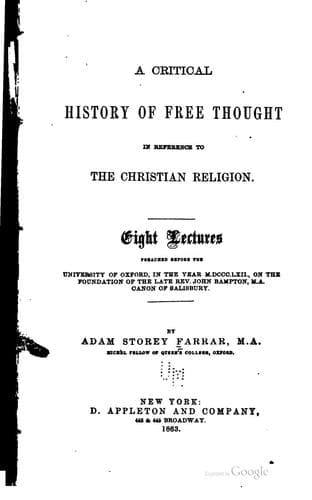
History of Free Thought in Reference to The Christian ReligionFarrar, Adam Storey
History
History of Free Thought in Reference to The Christian Religion
Farrar, Adam Storey
Free thought -- History
While the church has thus attempted a renovation of itself in doctrine,
the value of which some will dispute, all will allow thankfully that there
has been a deep increase of spiritual life throughout the German churches.
Religion indeed had never died out; but in the retirement of country
districts(859) the flame of divine love still burned with unextinguished
glory. This spiritual fire has now spread, and expressed itself in acts of
earnest life. Foreign missions have been promoted;(860) an inner or home
mission established for schools, and other religious agency;(861) and an
annual ecclesiastical diet(862) constituted, for promoting co-operation
and ecclesiastical improvement.(863)
These three separate movements of the present age, even when incorrect,
have contributed something to form a perfect theology. In the orthodox
school we see the attempt to return to the Bible, as interpreted by the
Reformation; in the mediation school, as interpreted by the religious
consciousness; in the critical school, as interpreted by historic and
critical methods.
We have now completed the history of the great movement in German
theology, in its two elements, doctrinal and critical. Commencing in the
first period,—in doctrine, with the disbelief of positive religion,
replacing dogma by ethics; and in criticism, supplying a rationalistic
interpretation: in the second, it was improved on the doctrinal side by
the separation of religion and ethics; and on the critical by a spiritual
acknowledgment of the literary characteristics and psychological
peculiarities of revelation: in the third, by a total reconstruction of
both inquiries, in a more historic and orthodox spirit; and by the
creation of a traditionalist position in reference to each. The solution
of the problem how to reconcile faith and reason, was attempted in the
first by obliterating faith; in the second by uniting them; in the third
by separating them. The whole movement stands remarkable, not only as
being the most singular instance in history, where the action of free
thought can be watched in its intellectual stages, disconnected in a great
degree from emotional causes, and where the effort was exercised by the
friends of religion, not by foes; but also in the circumstance that though
referable to the influence of similar intellectual causes as former epochs
of free thought, it is characterised by wholly different forms of them.
Public-domain text, read in full here on John Shaqi.
Reviews
Reviews
No reviews yet
Be the first to share your thoughts on this work.
Elsewhere in the archive
Join the Discussion
Join the discussion
Sign in to leave a comment or review.
Sign InorCreate an account