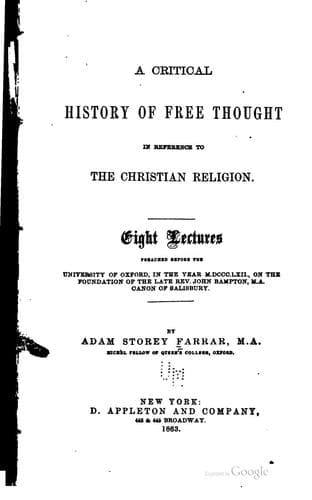
History of Free Thought in Reference to The Christian ReligionFarrar, Adam Storey
History
History of Free Thought in Reference to The Christian Religion
Farrar, Adam Storey
Free thought -- History
The panic caused by the revolutions of 1848 gave increased stimulus, by
adding a political reaction to the religious. The extreme rationalist
party had favoured the Revolution, and the school of Schleiermacher had
supported the schemes for constitutional government. In the suppression of
liberty which ensued for about ten years, the orthodox movement in
theology united itself with the reaction in political. Absolute government
was not merely a fact, but a doctrine. The theological reaction was no
longer the spiritual aspiration of Germany seeking repose after doubt, but
a political movement veiled under an ecclesiastical colour. The result has
been, the creation of a Lutheran party far more extreme in its opinions
than the one just described;—the political leader of which in the Prussian
parliament was the jurist Stahl;(856)—intolerant towards other churches,
suspicious of any independent associations for religious usefulness in its
own, disowning pietism because of its unchurchlike character, and in its
principles going back beyond the Reformation, discarding the subjective
inward principle, and reposing on the objective authority of the church.
Taking a political view of religion, it does not so much ask what is
truth, but what the church asserts to be true. Though not offending
popular prejudices by the introduction of Romish doctrines or rites, it
really reposes on the Romish principle of a visible authoritative church
with mystical powers, upholding a rigid sacramental theory and the
doctrine of consubstantiation. Extending the sacramental efficacy to the
ministerial office, and denying communion between God and the individual
soul independently of the church as the element of communication.(857) Yet
it contains many honoured names, and has produced many instructive works.
The movement in English theology, which originated a generation ago in the
panic caused by the liberal acts of the government which was introduced by
the reform act,(858) offers a parallel; with the exception that the
ecclesiastical principles then advocated had always had supporters in the
English church, whereas they were nearly new in the Lutheran. The Lutheran
movement too, only proposes to go back to the Reformation, the English
ecclesiastical movement professed to go back to the early fathers. (41)
Public-domain text, read in full here on John Shaqi.
Reviews
Reviews
No reviews yet
Be the first to share your thoughts on this work.
Elsewhere in the archive
Join the Discussion
Join the discussion
Sign in to leave a comment or review.
Sign InorCreate an account