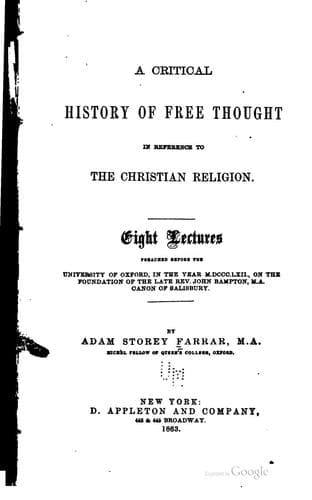
History of Free Thought in Reference to The Christian ReligionFarrar, Adam Storey
History
History of Free Thought in Reference to The Christian Religion
Farrar, Adam Storey
Free thought -- History
Contemporaneously with this socialist system was that of Fourier,(872)
which, though presented more as a scheme of social amelioration, and less
as a religion, implied the same abnegation of Christianity. Starting from
an avowedly pantheistic view of philosophy, the author of it gradually
passed through the sciences, until he arrived at man, and reached the
study of human history and constitutions. Exaggerating the good elements
of human nature, and ignoring the necessity for any other than a social
power to amend the heart, he traced the source of evil to social
competition, and proposed to rearrange society on the principle of
substituting co-partnership for competition.(873) The two ideas
accordingly which these speculations introduced were;—first, that European
society was approaching a crisis, the peculiarity of which, as distinct
from former ones, would be, that it would be an industrial revolution; and
the industrial mind would obtain the mastery of the administration; and,
secondly, that the accompaniment would be a new organization of industry
on the principle of co-operation. We cannot track these schools into their
ramifications(874) and their indirect expression in lighter
literature,(875) nor notice the levelling system of communism or
co-operative socialism which completed the cycle;(876) but it will be
remembered, that when the revolution of 1848 ensued, the schemes for
organization of labour were one of its peculiarities; the social republic
of those who regarded the democracy as a means, mixed with the political
republicans, who thought it to be an end.
It will be noticed that the schemes of these socialist philosophers,
though analogous as political theories, in proposing organization of
labour and consequent monopoly, to the English socialism of Owen before
named, are unlike it in philosophical origin and religious tendency. In
philosophical origin his system rests on sensation, theirs on feeling; his
degrades human nature, theirs elevates it. His denounces priestcraft as
imposture, and religion as obsolete; theirs, though identifying religion
and industry, regards religion as the highest expression of humanity, the
great goal to which nature is developing: his leads to deism or atheism,
theirs to pantheism. Yet theirs is not less hurtful, for they reject with
contempt the dogmatic teaching of revelation, though they appropriate the
Christian virtues; like the German philosophy they resolve the Deity into
a law, according to which the universe evolves.
Public-domain text, read in full here on John Shaqi.
Reviews
Reviews
No reviews yet
Be the first to share your thoughts on this work.
Elsewhere in the archive
Join the Discussion
Join the discussion
Sign in to leave a comment or review.
Sign InorCreate an account