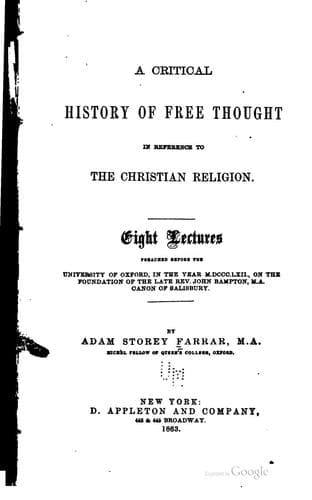
History of Free Thought in Reference to The Christian ReligionFarrar, Adam Storey
History
History of Free Thought in Reference to The Christian Religion
Farrar, Adam Storey
Free thought -- History
We may select the name of a writer who stands pre-eminent in critical
investigations connected with religion, as the best representative of the
tone assumed in reference to the Christian faith by the most highly
educated younger spirits of the French nation, of whose literature he is
one of the brightest living ornaments,—Ernest Renan.(891) Exhibiting a
mind of the rarest delicacy, and bearing traces of the collective
cultivation which arises from detailed acquaintance with most varied
branches of human culture, he has brought his vast acquaintance with the
Semitic tongues to bear on the historical criticism of portions of the
Hebrew literature; and has sketched with the hand of a master the great
passages in the history of religion,—the symbolism of mythology; the
monotheistic systems, Jewish, Christian, and Mahometan; the four chief
phases of Christianity, the Catholic, the Protestant, the Socinian, the
rationalist;(892) and has speculated on the future religious tendencies of
the age, in essays, which those who feel most deeply pained with the views
presented must acknowledge to be marked by rare power and freshness.
Possessing a delicate appreciation of the past, and a cheerful confidence
in the future; loving the advance of the knowledge of physical nature, yet
protesting against the tendency to materialism; dreading the democracy of
opinion, which threatens to suppress independence of inquiry by a power
analogous to centralization in the state; the artist no less than the
critic, imaginative as well as reflective, he may be studied as in all
respects the contrast to the French philosopher of the last century, and
as the type of the cultivated minds on whom Christianity has made its
impression. His view of philosophy is the one recently explained: his view
of religion and of Christianity, so far as we can gather it indirectly
from his criticisms, seems to mark a belief in the religious sentiment as
a subjective feeling, rather than in the reality of its external object of
worship. Its objective side seems to him to be a symbolism, and Christian
dogma to be an obsolete form of religious philosophy; inspiration a form
of natural consciousness; and even its highest expression to be but the
poetry, the art, of the imaginative faculties. There is audible at times
an undertone of despondency, as the sigh of one who has searched for truth
and not found it;(893) and who, in despair of discovering it on the
intellectual side, has taken refuge in the moral. Religion, vain
speculatively, is resolved by him into ethics. Faith expires in
conscience; dogma in morality. And this interesting writer closes his
speculations with the regret, that he feels himself isolated from those
Christian saints whose characters he regards as the purest in the
world.(894) Such may probably be regarded as the type of thought of the
most educated thinkers of France; a feeling of partial belief, partial
doubt; a keen appreciation of the beauty of the character of the great
Public-domain text, read in full here on John Shaqi.
Reviews
Reviews
No reviews yet
Be the first to share your thoughts on this work.
Elsewhere in the archive
Join the Discussion
Join the discussion
Sign in to leave a comment or review.
Sign InorCreate an account