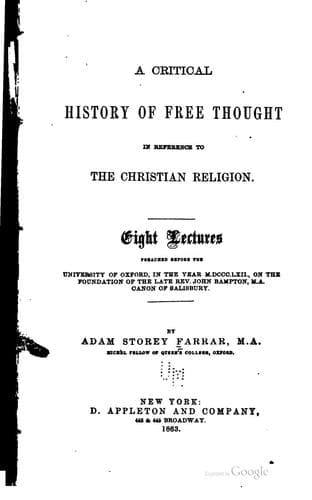
History of Free Thought in Reference to The Christian ReligionFarrar, Adam Storey
History
History of Free Thought in Reference to The Christian Religion
Farrar, Adam Storey
Free thought -- History
Since the re-establishment of the empire, some of the forms of philosophy
which have been described have almost disappeared. The socialist
philosophy has become extinct as a direct movement; the eclectic school
has gradually passed from philosophy to literature; and the chief
tendencies, so far as mere materialism does not, as in most reactions,
extinguish thought, are toward a modification of eclecticism on the one
hand, and to ultramontism on the other.(888)
The difference of this new eclecticism from the former kind seen in
Cousin, lies in the fact that while that was chiefly derived from
Schelling’s philosophy, this is an offshoot from Hegel. The one considered
that the mind, by its intuitions, can find absolute truth, and by the
light of these absolute ideas can criticise history, and prejudge the end
toward which society is moving. This denies the possibility of attaining
absolute truth. All being is a state of flux: all knowledge is relative to
its age. Philosophy expires in historical criticism; in the history of the
soul of man under its various manifestations. It rests in what is; it
judges only from fact. The absolute is displaced by the relative; being by
becoming.(889) Though not positivism in its aspects, this system is so in
its scientific results.(890)
The unbelief is critical, not aggressive. The grand idea of an historical
progress, of tracing especially the historic growth of ideas, of culture,
of the great unfolding of humanity, presides over religious speculations,
and lends its fascinating power and its danger. The necessity is
recognised for solving the nature of the religious consciousness, and
satisfying its wants; but the remedy is sought in other means than in
Christianity. While this is the condition of the philosophy just
described, positivism, so far as it prevails, is wholly antichristian, and
regards religion as the product of an unscientific age, for which a belief
in nature’s laws and science is a sufficient substitute. Christianity,
though the ripest of religious forms, is only symbolical of a higher truth
towards which humanity is tending.
Public-domain text, read in full here on John Shaqi.
Reviews
Reviews
No reviews yet
Be the first to share your thoughts on this work.
Elsewhere in the archive
Join the Discussion
Join the discussion
Sign in to leave a comment or review.
Sign InorCreate an account