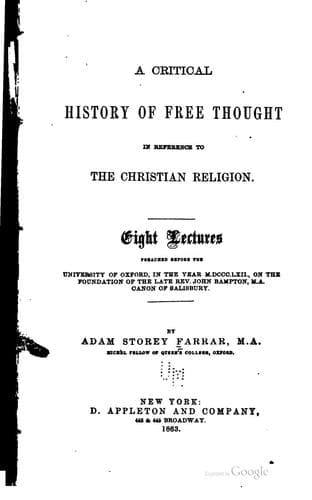
History of Free Thought in Reference to The Christian ReligionFarrar, Adam Storey
History
History of Free Thought in Reference to The Christian Religion
Farrar, Adam Storey
Free thought -- History
In the last lecture we brought the history of unbelief on the continent
down to the present time. In this, the concluding one of the series, we
shall complete the history of it in our own country or language during
this century; and afterwards deduce the moral of our whole historical
sketch, and suggest practical inferences.
In the account of unbelief in England, given in a previous lecture,(895)
we hardly entered upon the present century, except so far as to observe
the influence of the philosophy of the last on works of literature, such
as those of Shelley; or on political speculations, such as those of Owen.
Yet even here we were already made to feel the presence of the new
influences, which have completely altered the tone of unbelief. Even
Shelley’s later works, though marked by the outbursts of bitter passion
against religion, contain more of the spiritual perception which is the
characteristic of present thought:(896) and the oblivion into which Owen’s
system soon fell, save as it has been resuscitated in moments of political
disaffection, together with its failure to leave a permanent impression,
like the socialist systems of France, arose from the circumstance that the
one-sided survey of man’s nature, on which it was based, could not deceive
an age which was characterised by an increasing depth in its moral
perceptions.
The unbelief of the present day differs from that of the last century in
tone and character; and in many respects shares the traits already noticed
in the modern intellectualism of Germany, and the eclecticism of France.
It is not disgraced by ribaldry; hardly at all by political agitation
against the religion which it disbelieves: it is marked by a show of
fairness, and professes a wish not to ignore facts, nor to leave them
unexplained. Conceding the existence of spiritual and religious elements
in human nature, it admits that their subjective existence as facts of
consciousness, no less than their objective expression in the history of
religion, demands explanation, and cannot be hastily set aside, as was
thought in the last century in France, by the vulgar theory that the one
is factitious, and the other the result of priestly contrivance. The
writers are men whose characters and lives forbid the idea that their
unbelief is intended as an excuse for licentiousness. Denying revealed
religion, they cling the more tenaciously to the moral instincts: their
tone is one of earnestness; their inquiries are marked by a profound
conviction of the possibility of finding truth: not content with
destroying, their aim is to reconstruct. Their opinions are variously
manifested. Some of them appear in treatises of philosophy; others
insinuate themselves indirectly in literature: some of them relate to
Christian doctrines; others to the criticism of scripture documents: but
in all cases their authors either leave a residuum which they profess will
satisfy the longings of human nature, or confess with deep pain that their
Public-domain text, read in full here on John Shaqi.
Reviews
Reviews
No reviews yet
Be the first to share your thoughts on this work.
Elsewhere in the archive
Join the Discussion
Join the discussion
Sign in to leave a comment or review.
Sign InorCreate an account