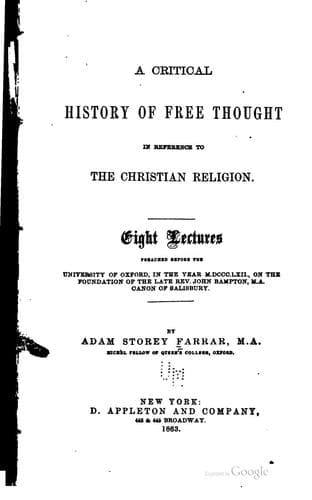
History of Free Thought in Reference to The Christian ReligionFarrar, Adam Storey
History
History of Free Thought in Reference to The Christian Religion
Farrar, Adam Storey
Free thought -- History
conclusions are in direct conflict with human aspirations; and, instead of
revelling in the ruin which they have made, deplore with a tone of sadness
the impossibility of solving the great enigma.
It is clear that writers like these offer a wholly different appearance
from those of the last century. The deeper appreciation manifested by them
of the systems which they disbelieve, and the more delicate learning of
which they are able to avail themselves, constitute features formerly
lacking in the works of even the most serious-minded deists,(897) and
require a difference in the spirit, if not in the mode, in which
Christians must seek to refute them.
The solution of this remarkable phenomenon is to be found in the universal
change which has passed over every department of mental activity in
England in the present century. The peculiar feature of it may be
described by the word _spirituality_, if that word be used to imply, in
contrast to the utilitarian and materialist tendencies of the last
century, the consciousness in ourselves, and appreciation in others, of
the operation of the human spirit, its rights, its powers, and its
effects. This conviction stimulates in one the vivid consciousness of duty
and moral earnestness; in another it hallows human labour, and throws a
blessedness around the struggles of industry; in another it kindles the
inspiration of art, breaking up conventionalities of style, or expresses
itself in poetry, in soliloquies on the inner feelings or in meditations
on life, as a set of problems to be explained by the heart. Elsewhere it
lifts the man of science above the grovelling idea that discoveries must
be sought solely for the purpose of utility. Again, transferring its
perception of the operation of spirit to the world of nature, it not
unfrequently attributes a soul thereto, and induces a subtle pantheism.
Sometimes too by a singular reaction it has a tendency, by the moral
earnestness which it stimulates, to depress intellectual speculation, and
to wear the appearance of fostering the utilitarianism which it combats.
Such is the central principle which characterises our literature, and
which, through the diffusion of reading, has moulded the public judgment,
and, operating in every department of educated thought, has even altered
the form in which unbelief expresses itself.
Probably the successive steps of the growth of this subjective tendency in
literature might admit of easy statement. The meditative school of poetry,
which flourished early in the century(898) among a few refined minds at
the English lakes; which loved to ponder mystically on nature or on the
spiritual world, or to catch the thought excited in the mind by nature,
and follow the series of thoughts which the law of mental association
suggested,(899) was one means of creating a subjective and spiritual taste
among the youth of the generation which succeeded.
Public-domain text, read in full here on John Shaqi.
Reviews
Reviews
No reviews yet
Be the first to share your thoughts on this work.
Elsewhere in the archive
Join the Discussion
Join the discussion
Sign in to leave a comment or review.
Sign InorCreate an account