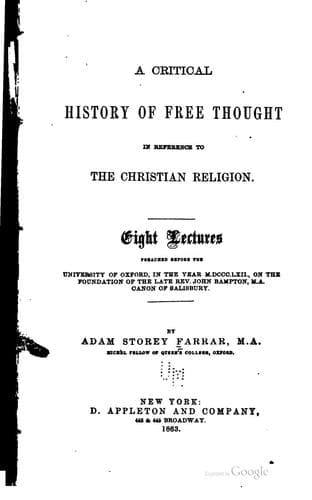
History of Free Thought in Reference to The Christian ReligionFarrar, Adam Storey
History
History of Free Thought in Reference to The Christian Religion
Farrar, Adam Storey
Free thought -- History
The most obvious arrangement would be to place the writers in groups,
according as they manifest a tendency toward atheism, pantheism, deism, or
rationalism,(902) respectively; but the mode which more nearly accords
with our general purpose would be to adopt a philosophical rather than a
theological classification, and arrange them according to the variety in
the tests of truth employed by them, and the sources from which their
arguments start, rather than the conclusions at which they arrive. Perhaps
the advantage of both plans will be in a great degree combined, if we
classify them according to the branch of science, physical, mental, or
critical, from which the doubts take their rise.
We shall commence with those writers who make sensation to be the last
appeal in belief, or whose doubts arise either from the methods or the
results of physical science. This class of opinions varies from positive
disbelief of the supernatural, generated by the fixed belief in the
stability of nature and disbelief of miraculous interference, to merely
isolated objections suggested by the conflict between the discoveries of
natural science and the statements of holy scripture.
The name which most fitly describes the extreme form of unbelief is
Positivism.(903) This system of philosophy, already stated to have been
invented by Comte, is silent about the existence of a Deity. It inculcates
the belief in general laws, and acknowledges the order in Nature, which we
are accustomed to regard as the result of mind; but declines to argue to
the existence of a designing mind, where the evidence cannot be verified
by proof referable to sensation. Nature’s laws are in its view the only
Providence; obedience to them the only piety. A few minds may be found,
which not only accept the positive philosophy, but even receive the
religion taught in the positivist catechism.(904) Unable to satisfy the
longings of their heart by this system of Cosmism, they receive the
extravagant idea of the worship of humanity, which Comte invented in his
later days.
Public-domain text, read in full here on John Shaqi.
Reviews
Reviews
No reviews yet
Be the first to share your thoughts on this work.
Elsewhere in the archive
Join the Discussion
Join the discussion
Sign in to leave a comment or review.
Sign InorCreate an account