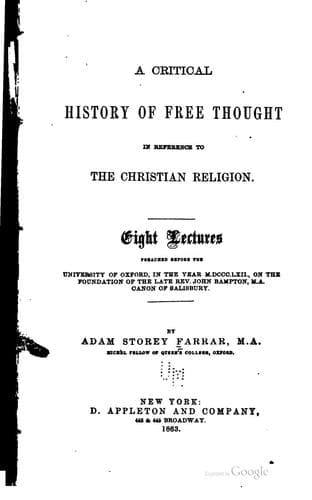
History of Free Thought in Reference to The Christian ReligionFarrar, Adam Storey
History
History of Free Thought in Reference to The Christian Religion
Farrar, Adam Storey
Free thought -- History
Another cause was found in the philosophy which arose. The years following
the general declaration of peace, while the public attention was directed
to the political reforms which were consummated in the Reform act, were
marked by the thorough investigation of the first principles of every
branch of knowledge. Two minds of that period have, more than any other,
affected the succeeding generation; the one a utilitarian philosopher, the
other an intuitional.
Both alike carried out the system which Descartes and Bacon had
inaugurated, of finding the standard of truth in the analysis of the
powers of the human understanding. But Bentham criticised to destroy the
past; Coleridge to rebuild it. The one asked, Is a doctrine true? The
other asked, what men had meant by it who had thought it so?(900) The one
overlooked the truth previously known; the other too boldly strove to
rebuild it from his own consciousness, after surrendering the old proofs
of it. The one, with the practical spirit of the Englishman, looked upon
an opposing opinion only as an object suited for attack; the other, with a
spirit caught from Germany, felt that there was some truth everywhere
latent. But both were reformers; both stimulated the revolt against the
cold spirit of the last century; both contributed to create, the one
indirectly, the other intentionally, a subjective spirit by their
psychological analysis.
Even movements which at first sight seem most alien to this spirit in
character, have really been affected unconsciously by it.(901) The
ecclesiastical reaction which sprang up about a quarter of a century ago,
though seemingly most objective in its nature, witnessed not less than the
very opposite, or rationalistic tendency, to the presence of this
influence. For both alike were founded on the idea that religion lacked a
philosophical groundwork: both sought a new ground of faith different from
that of the last century; the one in those utterances of consciousness
which created a reverence for historic tradition; the other in those
intuitions which were supposed to rise above scripture and tradition, and
to form the basis and measure of both.
The causes just named in literature and philosophy respectively, are some
of those which have contributed to create or to foster the change in the
character of the literature, and in the spirit of the age, which has
produced the alteration of tone which exists in the modern sceptical
literature.
In passing from these remarks on the peculiarly subjective tone of modern
unbelief, and the literary influences which have produced the general
change in the public taste, of which it is only one example, to an
enumeration of the authors who have given expression to doubt, and of the
specific forms of doubt now existing, we encounter a difficulty of
classification.
Public-domain text, read in full here on John Shaqi.
Reviews
Reviews
No reviews yet
Be the first to share your thoughts on this work.
Elsewhere in the archive
Join the Discussion
Join the discussion
Sign in to leave a comment or review.
Sign InorCreate an account