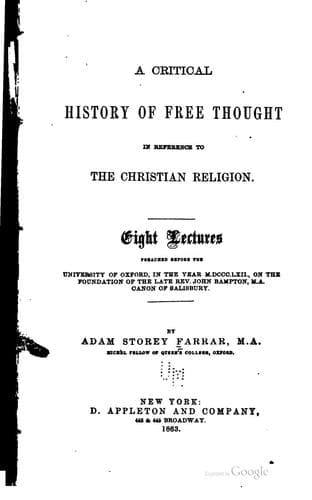
History of Free Thought in Reference to The Christian ReligionFarrar, Adam Storey
History
History of Free Thought in Reference to The Christian Religion
Farrar, Adam Storey
Free thought -- History
Nor is the danger confined to the various branches of secular literature:
the views of even religious men are not unfrequently modified by it, or
painful doubts are created where the head contradicts the heart. In
proportion as phenomena are shown not to depend on chance, the misgiving
is felt as to the reality of special providence and the value of prayer,
in reference to temporal affairs. The sphere for confiding petitions is
felt to be narrowed; and miracles, instead of becoming an evidence for
religion, become a difficulty. Even where fundamental difficulties, such
as these, do not sap the religious life, the belief that the inspiration
of the sacred books guarantees the truth of the views of physical science,
the cosmogony, physiology, ethnology, and chronology, contained therein,
creates a further body of difficulties,(908) less fundamental but more
painful, because founded on the apparent want of harmony of scripture with
the progressive discoveries of natural science.
While these are the species of temptations to unbelief which appertain to
one source of opinions, viz. that which relies upon sensation as the
ultimate test of truth; doubts similar in character, though different in
cause, manifest themselves in that portion of our literature which appeals
for its proof to the faculty of insight, and which believes in mental
sources of information which are independent of sensation. If the one
tends towards atheism, or to a deism in which the world is viewed as a
machine; the other tends towards pantheism or to naturalism, wherein no
opportunity for interposition by miraculous revelation is retained, but
the inner consciousness of man is regarded as able to create a religion.
The former class of views belongs to minds accustomed to experimental
science; this to those which are conversant with spiritual or æsthetic
subjects: the former expresses itself in the region of science, and tempts
men of thought; the latter expresses itself rather in the region of
literature, and tempts men of sentiment.
One writer, a prince in the region of letters,(909) may be adduced, many
of whose works imply, directly or indirectly, a mode of viewing the world
and society contrary to that which is taught in Christianity. He is the
highest type of the antagonist position which literature now assumes in
reference to the Christian faith, and which finds some parallel in the
contest which occurred in Julian’s time, and at the Renaissance.
Public-domain text, read in full here on John Shaqi.
Reviews
Reviews
No reviews yet
Be the first to share your thoughts on this work.
Elsewhere in the archive
Join the Discussion
Join the discussion
Sign in to leave a comment or review.
Sign InorCreate an account