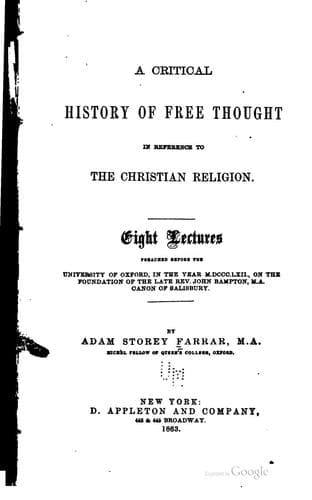
History of Free Thought in Reference to The Christian ReligionFarrar, Adam Storey
History
History of Free Thought in Reference to The Christian Religion
Farrar, Adam Storey
Free thought -- History
Though possessing too much originality to borrow consciously from the
literature of Germany, yet it is easy to discover that the fire of his
imagination has been kindled in contact with the marvellous insight of
Goethe, the pathos of Jean Paul, and the faith in eternal truth which
marked Jacobi. Their rival rather than disciple, he hails the philosophy
of his own country as a first approximation to truth; but regards the
German mind as having seen more deeply than any other of modern times into
the mysteries of existence. Though not formal enough to throw his
philosophy into a system, he has left an impress on the English literature
of this century. In every branch of literature which he has surveyed, he
has made it his mission to expose the hollow formalism, the cold
materialism, which he considers that utilitarian philosophy had produced.
“Self in the sense of selfishness, and God as the artificial property of a
party;” these have been said to be the two faults which he sees in
politics, in science, in law, in literature, in religion: and, to oppose
this inrush of objective knowledge; to call man to a recognition of his
better self, to the unaltering spiritual laws stamped in the structure of
the human consciousness, and to God as the eternal, infinite Divinity,
whose presence fills creation; this is the mission which he has striven to
effect.
Yet can there be no doubt that the victory of this great truth is won at
the sacrifice of others; and that in the general tone of his writings, and
above all in his memoir of the doubter Sterling,(910) he occupies a
position opposed to the particular forms of religious truth taught by
Christianity, and one which a philosopher of tastes cognate to his own,
Coleridge, forming himself under the psychological rather than the
literary influence of German thought, strove to retain. In elevating the
doctrine of the revelation in the soul, he regards as unnecessary the
revelation in the book:(911) his teaching tends to inculcate a worship of
earnestness, and to ignore all consideration of the object toward which
the earnestness is directed. In asserting the reality of spiritual laws in
the soul, he has implied the veracity of all religions, caring only for
the subjective zeal of the believer, not for the objects of his
belief.(912) In opposing the mechanical view of the universe, he is so
overwhelmed with the mystery which belongs to it, that the soul recoils in
the hopelessness of speculation, to rest content with work rather than
belief. And his readers, attracted by his power of satire and depth of
insight, expressed in a style full of force by reason of its peculiarity,
return to their daily life after imbibing his teaching, excited to greater
earnestness and faithfulness, but filled, it is to be feared, with a
contempt for objective systems, for dogmatic truth, and for the Christian
creed.(913)
Public-domain text, read in full here on John Shaqi.
Reviews
Reviews
No reviews yet
Be the first to share your thoughts on this work.
Elsewhere in the archive
Join the Discussion
Join the discussion
Sign in to leave a comment or review.
Sign InorCreate an account