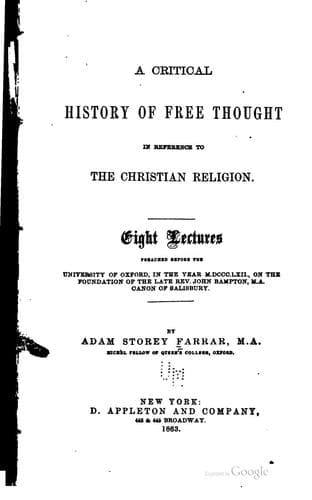
History of Free Thought in Reference to The Christian ReligionFarrar, Adam Storey
History
History of Free Thought in Reference to The Christian Religion
Farrar, Adam Storey
Free thought -- History
We have hitherto exhibited the systems in the present day, which by their
influence, direct or indirect, assume a position antagonistic to
Christianity. Commencing with positivism, we explained the doubts which,
being built on a sensationalist basis, reject the possibility of
revelation; or, on an ideal, reject its necessity. We now proceed to
describe the works written as direct attacks upon Christianity, founded
indeed on an idealist basis, but in which the philosophy is in the main
subordinate to the critical investigation. Marked by the improved tone
which was before described, and enriched with the fruits of the researches
of German theologians, they form at once the books which are likely to
meet us in daily life; and equal those of past generations in subtlety and
danger. We shall commence with those which are most openly infidel, and
gradually pass onward to those which shade off almost into unitarianism,
until we reach the critical difficulties which in the writings of avowedly
Christian professors have given ground for the charge of rationalism.
The first writer to be named(916) is one who in two works, the one “a
Comparison of the Intellectual Progress of Hebrews and Greeks in their
religious development,” the other on “the Origin of Christianity,” has
made a daring attempt, not to refute Christianity directly, but to grapple
with the historic problem of the origin of revealed religions; and
endeavoured to explain them by regular historic and psychical
considerations. In making this attempt he has availed himself of the
modern investigations into mythology, and the relation which it bears at
once to the soul, to philosophy, and to religion. In the last century
mythology was either derided in a Lucian-like spirit, or else regarded as
the relic of primitive traditions. In the present these views have mostly
disappeared; and the theories which exist in reference to it are chiefly
two, in the one of which myths are explained by nature-worship, and sacred
mysteries, and are regarded as parables descriptive of natural processes;
in the other they are regarded as being connected with the origin of
language, and the transfer of names from one object to another. (47) It is
the former view which this writer has employed. Commencing with the Hebrew
Cosmogony,(917) he traces the origin of the metaphysical notion of
God(918) through personification and polytheism, up to theism; and next
the origin of the moral notion of God,(919) regarding the notion of a fall
to be a hypothesis to account for sin; and explains away the idea of
mediation by the absurd theory of supposing it to be made up of the two
notions, of emanation, and of a waning deity derived from the
personification of natural processes.(920) Having thus used mythology, in
the manner of Volney, to illustrate the rise of these conceptions among
the Greeks and Hebrews respectively, he enters(921) upon the religious
history of the Hebrew people, and attempts to show that the idea of the
Public-domain text, read in full here on John Shaqi.
Reviews
Reviews
No reviews yet
Be the first to share your thoughts on this work.
Elsewhere in the archive
Join the Discussion
Join the discussion
Sign in to leave a comment or review.
Sign InorCreate an account