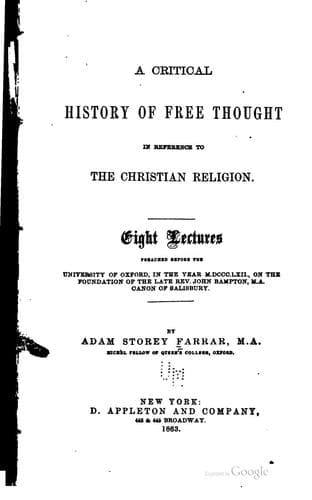
History of Free Thought in Reference to The Christian ReligionFarrar, Adam Storey
History
History of Free Thought in Reference to The Christian Religion
Farrar, Adam Storey
Free thought -- History
theocracy with temporary rewards suggested the two correlative ideas of
temporary reverse, and eventual restoration; and thus, by the
personification of the people’s suffering, led to the idea of a suffering
Messiah.(922) Discussing the complex Messianic conception, he tries to
explain its origin by natural causes, by resolving it(923) into a
combination of the different types of thought, presented in the earlier
history. Approaching the subject of Christianity, he considers it to be
one of the Jewish sects, a lawful continuation of the prophetic
reforms;(924) therein anticipating the idea which he has developed in the
second work above named, concerning the rise and progress of Christianity;
in which he has adopted the views of the historical criticism of the
school of Tübingen. Regarding Christianity to be a reform of Judaism mixed
with Greek dogmas,(925) he attributes to St. Paul, in contrast to the
Jewish apostles, the idea of giving it universality; and to the early
Roman church the idea of giving it unity;(926) illustrating by natural
causes the gradual origin of the church,(927) and the pretended concretion
of dogmas(928) by mixture with Alexandrian philosophy.
These works, too recondite to be popular, and too unsatisfactory to be
dangerous, do not appear likely to affect largely the English inquirer;
but the case is different with the work which next meets us by another
author, “the Creed of Christendom,”(929) which, on account of its
clearness of statement and variety of material, is the most dangerous work
of unbelief of this age.
Public-domain text, read in full here on John Shaqi.
Reviews
Reviews
No reviews yet
Be the first to share your thoughts on this work.
Elsewhere in the archive
Join the Discussion
Join the discussion
Sign in to leave a comment or review.
Sign InorCreate an account