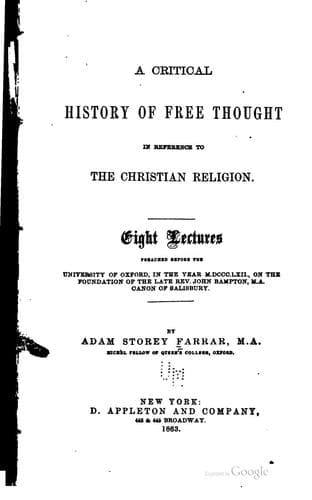
History of Free Thought in Reference to The Christian ReligionFarrar, Adam Storey
History
History of Free Thought in Reference to The Christian Religion
Farrar, Adam Storey
Free thought -- History
It is perhaps to the influence of Coleridge, more than to that of any
other single person, that the origin of this philosophical movement can be
traced.(975) We have already(976) had occasion to mention the general
design of his philosophy. At a time when the world was wishing to break
with the past, in politics, in literature, and in religion, his spirit was
conservative of older truth, while sympathetic with that which was new. In
looking backwards, he sought to discover what mankind had meant by their
beliefs; in looking around, he asked what were the elements which the
present generation disapproved: and, wishing to eliminate the error of the
past and appropriate the truth of the present, he looked inwards into the
human heart, and thought that he perceived a faculty there which unveiled
to man the eternal, absolute truth,—the true, the beautiful, and the good;
which had been the object of search in all systems, the end for which all
earnest spirits had ever yearned. This faculty, “the reason” or intuition,
thus became the guide, by the light of which he was able to thread his way
through the manifold systems of thought of past times.(977) Not content
with applying it to other subjects, he carried it also into the domain of
revealed religion. It was the engine by which he hoped to get a view of
the truth which the ancient writers of holy scripture intended to convey.
It would become the means of interpreting their thoughts, by raising the
student to a perception of the same objects, similar in kind to that which
they possessed. Their inspiration was regarded as only an elevated form of
this faculty. When accordingly this method was applied by him to the study
of Christianity, it did not lead him to pare down the supernatural by the
cold interpretation of the older rationalism, but gave the explanation of
the mysteries by raising men to a state where mysteries ceased to be such
any longer. It did not pull down revelation to the level of the mind, but
strove vainly(978) to raise the mind to a level with revelation.
Public-domain text, read in full here on John Shaqi.
Reviews
Reviews
No reviews yet
Be the first to share your thoughts on this work.
Elsewhere in the archive
Join the Discussion
Join the discussion
Sign in to leave a comment or review.
Sign InorCreate an account