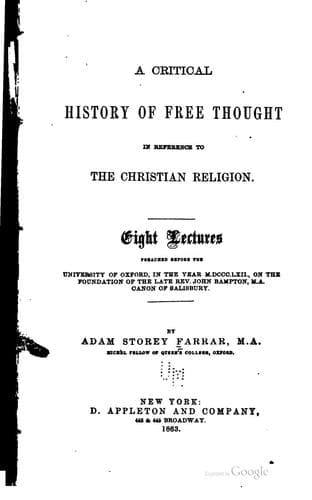
History of Free Thought in Reference to The Christian ReligionFarrar, Adam Storey
History
History of Free Thought in Reference to The Christian Religion
Farrar, Adam Storey
Free thought -- History
If viewed in reference to cognate schools of Christian philosophy, it
bears similitude in many respects to some of the schools of Germany. In
the analysis offered of the human faculties, it has much akin to Kant: in
the deep conviction that the highest truth is revealed to a faculty of
faith, and in the undoubting belief in our own intuitions and the
conviction of their reality, it resembles Jacobi and Schelling: in
regarding the human reason to be the impersonal reason, the divinity in
man, it resembles Schelling or Cousin. But it also has an element akin to
the ancient Neo-Platonic philosophy of Alexandria.(979) This is seen both
in the view taken of the organ of knowledge, and in the scheme of
philosophy evolved by it. The intuitive reason, the divine faculty above
described, which reveals eternal truth, is viewed as the divine Λόγος in
man, as was taught by the Neo-Platonists.(980) Inspiration is the action
of the same Λόγος. This branch of human intellect is absorbed in divinity:
a divine teacher is considered to exist in the human mind.(981) And as the
view of the faculty is parallel with the teaching of this ancient school,
so the explanations suggested of divine mysteries(982) like the Trinity or
Redemption are similar. These explanations are the mystical expressions of
the thoughts apprehended by this faculty, when it strives to raise itself
to oneness with the infinite object which it contemplates.
These remarks will explain the philosophical system taught by Coleridge,
and will furnish the clue to interpret the form of theological thought
which has originated from him. The parallel between his system and those
with which it has now been compared, will be no less obvious in noticing
the results of it. The system of Schleiermacher was the theological
corollary from the theories of German philosophy above named; and the
school of the Alexandrian fathers was the corresponding one which resulted
from the Neo-Platonic.(983) We should therefore expect that, if the
philosophy of Coleridge was a mixture of the two schools above described,
the teaching of his disciples would combine the two theological schools
which flowed from those systems. Attentive consideration of the
philosophical side of the modern movement of free thought in English
theology will confirm this anticipation, and show that its chief elements
are a union of these two theological schools. The tendency to require that
the human soul shall apprehend divine mysteries intellectually, as well as
feel their saving power emotionally; the reduction of inspiration
theologically, as well as psychologically, to an elevated but natural
state(984) of the human consciousness; the inclination to regard the work
of Christ as the office of the divine teacher to humanity, and human
history as the longing for such a divine voice; the description of the
work of Christ as a divine manifestation of a reconciliation which
previously existed, instead of being the mode of effecting it; the
Public-domain text, read in full here on John Shaqi.
Reviews
Reviews
No reviews yet
Be the first to share your thoughts on this work.
Elsewhere in the archive
Join the Discussion
Join the discussion
Sign in to leave a comment or review.
Sign InorCreate an account