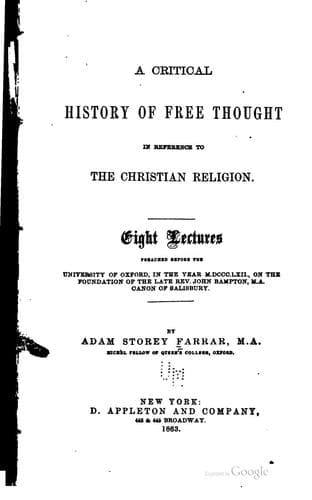
History of Free Thought in Reference to The Christian ReligionFarrar, Adam Storey
History
History of Free Thought in Reference to The Christian Religion
Farrar, Adam Storey
Free thought -- History
moderation of true learning, joined to the uncompromising adherence to the
Christian faith.
The history now given, of the doubt which is expressed at present through
the English language, completes the account of the fourth great crisis of
belief in church history;(994) and with it we bring to an end our long
survey of the history of free thought.
-------------------------------------
Since the commencement of the second lecture, we have been so involved in
the details of the investigation, that, to those who have lost sight of
the plan proposed in the commencement, the lectures may have appeared
historical rather than controversial, and hardly compatible with the
purpose of the founder of the Lecture. We have been like travellers moving
in a tangled plain, where the path at times seems lost. Before entering
upon it, we took our stand, as it were, on an eminence; and indicated the
plan of the route; pointed to the kind of territory through which it would
conduct us, and the direction to which it would tend. Now, that we have at
last extricated ourselves from its windings, and rest after our journey,
let us cast a glance backward over its course, and see how far the result
has verified our anticipations. Let us reconsider the purpose designed by
this course of inquiry; notice how far the promises in respect to it have
been fulfilled; show its relation to controversial purpose; and collect
the moral lessons which are derivable.
It will be remembered that we stated(995) the topic to be, a critical
history of free thought in Europe in relation to the Christian religion.
Our criticism started from a Christian point of view, and assumed alike
the miraculous character of Christianity, the exceptional character of the
religious inspiration of the first teachers of it, and the reality of its
chief doctrines. From this point of view we proposed to consider the
attempts of the human mind to get free from the authority of the Christian
religion, either by rejecting it in whole or in part.(996) Four great
crises of faith were enumerated in church history;(997) the first, the
struggle, literary and philosophical, of early heathenism against
Christianity;(998) the second, the reawakening of free thought in the
middle ages;(999) the third, that which appertained to the revival of
classical literature;(1000) the fourth, to the growth of modern
philosophy;(1001)—a series of epochs which exhibit the struggle of
Christianity in the great centres of thought and civilization, ancient or
modern; and it was proposed that our investigation should not only contain
a chronicle of the facts, but explain the causes, and teach the
moral.(1002) We considered that the causes which make thought develope
into unbelief are chiefly two,—the emotional and the intellectual;(1003)
and, while vindicating distinctness of operation for the intellectual
under certain circumstances,(1004) yet we allowed the union of them with
Public-domain text, read in full here on John Shaqi.
Reviews
Reviews
No reviews yet
Be the first to share your thoughts on this work.
Elsewhere in the archive
Join the Discussion
Join the discussion
Sign in to leave a comment or review.
Sign InorCreate an account