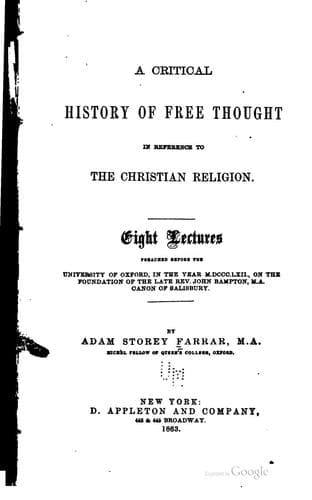
History of Free Thought in Reference to The Christian ReligionFarrar, Adam Storey
History
History of Free Thought in Reference to The Christian Religion
Farrar, Adam Storey
Free thought -- History
the moral to be so intimate,(1005) that not only must account always be
taken of the latter in estimating the unbelief of individuals, but the
exclusive study of the former, without allowing for the existence of the
latter, must be regarded as likely to lead to an imperfect and injurious
idea of unbelief.
The intellectual causes were however selected as the special subject of
our study;(1006) partly because they have been much neglected by Christian
writers, partly because they are the forms which for the most part create
the doubts which Christians encounter in the present age. The principal
intellectual causes were considered(1007) to be, either the new material
of knowledge, such as the physical or metaphysical sciences, which may
present truth antagonistic to the teaching of the sacred literature; or
new methods of criticism, the application of which creates opinions
differing from those of the traditionary belief; and, above all, the
effects of the application of particular tests of truth,—sense, reason,
intuition, feeling,—to the doctrines of revealed religion.
This was our plan; and we have been employed in tracing the influence of
these causes in generating doubt in the four great crises, with a
minuteness which may almost have been tedious; endeavouring to supply the
natural as well as the literary history; analysing each successive step of
thought into the causes which produced it; searching for them when
necessary in the intellectual biography of individuals; and, if not
refuting results, at least laying bare by criticism the processes through
which they were attained. At the same time we have attempted to show the
grounds on which the faith of the church has reposed in the various ages
of history. A defence, itself also twofold in its character—emotional and
intellectual—has been generated by the attack in each of the crises, and
an example thus furnished of the law which governs human society,—progress
by antagonism. Permanent gain to truth was seen to be the result of the
various controversies; quiet and refreshment after the discharge of the
storm had cleared the atmosphere from the intellectual and moral ills with
which it was charged.
The utility of the inquiry will now, it is hoped, be apparent. Though
these lectures must be regarded as instructive for the believer, rather
than polemic against the unbeliever, yet they are intended to serve also a
controversial purpose.
Public-domain text, read in full here on John Shaqi.
Reviews
Reviews
No reviews yet
Be the first to share your thoughts on this work.
Elsewhere in the archive
Join the Discussion
Join the discussion
Sign in to leave a comment or review.
Sign InorCreate an account