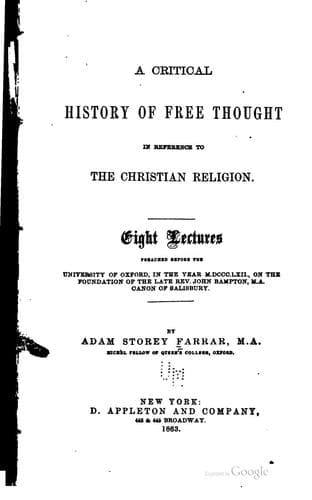
History of Free Thought in Reference to The Christian ReligionFarrar, Adam Storey
History
History of Free Thought in Reference to The Christian Religion
Farrar, Adam Storey
Free thought -- History
If accordingly a clergy is to be trained up likely to supply the
intellectual cravings of the present day, they must be placed on a level
with its ripest knowledge, and be acquainted with the nature and origin of
the forms of doubt which they will encounter. The church has indeed a
large field, where work and not thought is to be the engine which the
clergy must use in their labours; truly a home mission, where men and
women for whom Christ died, require to be lifted out of their mere
animalism, and taught the simplest truths of Christ, and prayer, and
immortality: and noble are the efforts that Christians have made, and are
making, for an object so religious and philanthropic; but there is a
danger lest this very energy of work, which accords so naturally with the
utilitarianism of the English character, should lead us to forget that
there is an opposite stratum of society, to which also Christianity has
its message, which is only to be reached by the delicate gifts of
intellect and by the ripest learning.
If Christianity is to be presented to this class, adapted to the demands
of the age so far as they are reasonable, but unmutilated and unaltered in
its body of revealed doctrine, preserving in its integrity the faith
delivered to the saints; so that apostles might recognize it as being that
which they themselves taught, and for which they laid down their lives; it
is necessary that Christian students should be trained specially for the
work, by a learned and intelligent appreciation of truth, such as will
create orthodoxy without bigotry, and charity without latitude. If we have
to dread their going forth with hesitating opinions, teaching, through
their very silence concerning the mysterious realities which constitute
the very essence of Christianity, another gospel than that which was once
for all miraculously revealed; there is almost equal ground for alarm if
they go forth, able only to repeat the shibboleths of a professional
creed, and unable to give a reason of the glorious hope that is in them.
In the former case they will fail to teach historic and dogmatic
Christianity, because they do not believe it; in the latter because they
do not understand its meaning and evidence. If they need piety as the
first requisite, they need knowledge as the second. In certain conditions
of the church, study is second only to prayer itself as an instrument for
the Christian evangelist.
It is hoped, therefore, that a sketch of a department not previously
treated as a whole, may indirectly be an aid to the Christian faith, if it
shall perform the humble office of supplying some elements of instruction
to the Christian student.
Public-domain text, read in full here on John Shaqi.
Reviews
Reviews
No reviews yet
Be the first to share your thoughts on this work.
Elsewhere in the archive
Join the Discussion
Join the discussion
Sign in to leave a comment or review.
Sign InorCreate an account