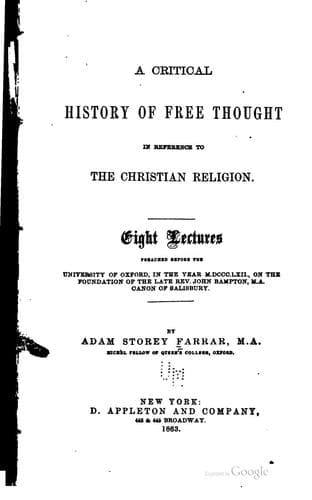
History of Free Thought in Reference to The Christian ReligionFarrar, Adam Storey
History
History of Free Thought in Reference to The Christian Religion
Farrar, Adam Storey
Free thought -- History
Such a purpose however would hardly have justified the introduction of the
subject here. The motive which dictated its consideration was much more
practical. It was hoped that the answer to many species of doubt would be
found by referring them to the forms of thought or of philosophy from
which they had sprung; that it would be possible to perceive how they
might be refuted, by understanding why and how men have come to believe
them.(1010) This is a study of mental pathology seldom undertaken. The
practical aim of Christian writers has generally suggested to them a
readier mode of treating the history of unbelief, by referring its origin
to intellectual pride; and, if any margin remained unaccounted for by this
explanation, to refer it to an invisible agent, the direct operation of
Satan.(1011) Such a method, however true, commits the error, against which
Bacon utters a warning, of ascending at once to the most general causes
without interpolating the intermediate. It ignores the intellectual class
of causes, and omits to trace the subtlety of their mode of
manifestation;—a problem equally interesting, whether they be regarded as
original causes of doubt, or only as secondary instruments obeying the
impulse of the emotional causes. It would have been possible to
investigate the subject, by selecting a few leading instances to
illustrate the natural history of doubt; but the most likely mode for
exhausting the subject, as well as for presenting it in a manner which
would fall in with the historic tastes of the age, seemed to be, to treat
it by means of a critical history, presenting the antidote by a running
criticism; and to ask, frankly and fully, what have been the grounds on
which Christianity has been doubted; and what have been those on which the
faith of Christians in their hour of peril has reposed; and then finally
to gather up the lessons which the history itself teaches.
The inquiry has been analogous to the study of the history of a disease;
and scientific rigour required that it should be conducted with a similar
spirit of fairness towards those that manifest its symptoms. As the
physiologist, who wishes to learn the laws of a disease, watches patiently
the symptoms in the subject of it, not reproaching the sufferer, even if
the malady be self-caused; so in moral diagnosis, the student of mental
and religious error must carry out his inquiries in the spirit of cold
analysis, if he would arrive at the real character of the intricate facts
which he studies. The candour of our examination has not been prompted by
any spirit of indifference to truth, nor by sympathy with error; but
partly by the demands of historical accuracy, partly by deep pity for
those who are the subject of spiritual doubts, even when the doubts are of
their own fault.
Public-domain text, read in full here on John Shaqi.
Reviews
Reviews
No reviews yet
Be the first to share your thoughts on this work.
Elsewhere in the archive
Join the Discussion
Join the discussion
Sign in to leave a comment or review.
Sign InorCreate an account