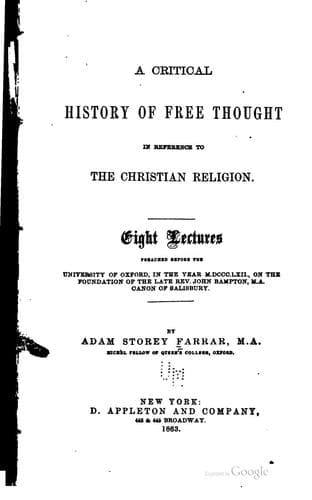
History of Free Thought in Reference to The Christian ReligionFarrar, Adam Storey
History
History of Free Thought in Reference to The Christian Religion
Farrar, Adam Storey
Free thought -- History
This view of the inquiry, as an analysis of the intellectual causes of
doubt, will also explain one or two peculiarities in it, which, if left
unnoticed, might leave an impression of its inutility.
It will be seen, for example, that in the investigation of the natural
history of doubt, and in the explanation of the antecedent metaphysical or
critical questions which have produced it, we have indicated the schools
of thought which have created it, but have abstained from insisting on the
inherent necessity of the relation which subsists between the metaphysical
tests of truth and the religious conclusions discussed. The reason is,
that it seemed unfit to assume a side eagerly in the metaphysical
controversy; and therefore, while showing that the use of certain grounds
of belief and methods of inquiry has produced, both as a matter of history
and logic, certain species of doubt or disbelief; we have not attempted to
condemn the particular metaphysical theories on the ground of the logical
consequences which are supposed to flow from them, nor to deny that they
could be so amended, as either to avoid the sceptical conclusions to which
our objections are taken, or be rendered innocuous by the co-existence of
other causes. Science only shows the general tendency or law of logical
connection between intellectual causes and effects. The production of the
results in particular cases is subject to exception from the introduction
of interfering causes.(1012)
Another peculiarity which appertains to the analysis of the intellectual
sources of doubt, besides the seeming absence of invariable necessity in
their operation, might be thought to destroy the practical value of the
inquiry; viz. the feeling of disappointment excited when it is perceived
that they do not wholly explain the phenomenon, and are merely antecedents
or elements, not causes. This arises from the very nature of mental
analysis. Being in nature like chemical, it aims only at the detection of
the elements that make up the compound, and furnishes the material or
formal causes, not the efficient. This longing of the mind to find causes,
and to discover the original motive power, is however a witness to the
ineffaceable connection of the idea of power with that of will. And while
it does not destroy the completeness of the analysis, as the solution of
the intellectual problem proposed, it nevertheless points to the
instinctive wish of the heart to resolve the causes of doubt into some
ultimate source in the will; and is thus a witness to the truth of the
position which we have always asserted,(1013) that the intellectual causes
selected for our special study are only one branch, and must be united to
the emotional in order to attain a full explanation of the phenomenon of
doubt.
Thus the analysis offered will have, it is hoped, a utility in the limited
sphere which was claimed for it, in supplying the account of the tangled
and subtle processes through which doubt has insinuated itself.
Public-domain text, read in full here on John Shaqi.
Reviews
Reviews
No reviews yet
Be the first to share your thoughts on this work.
Elsewhere in the archive
Join the Discussion
Join the discussion
Sign in to leave a comment or review.
Sign InorCreate an account