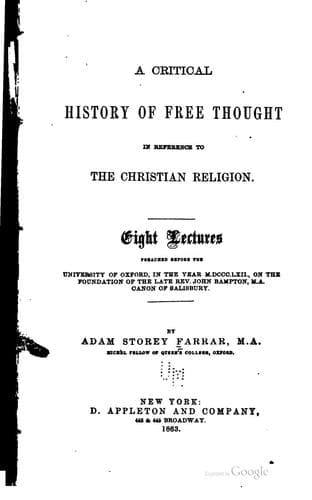
History of Free Thought in Reference to The Christian ReligionFarrar, Adam Storey
History
History of Free Thought in Reference to The Christian Religion
Farrar, Adam Storey
Free thought -- History
While Christians have thus generally regarded free inquiry in religion as
wholly a loss; freethinkers have taken the very opposite view, and
regarded it as an unmixed gain. The distinguished writer(1016) of our own
time on the history of civilisation, whose premature death will prevent
the fulfilment of his large design, has illustrated, with the clearness
and grasp over facts which constitute some of his excellences, the office
of scepticism, in securing for the human mind the political liberty and
toleration which he prized so dearly. His central thought was, that
civilisation depended upon the progress of intellect,(1017) the
emancipation of the human mind from all authority save that of inductive
science: he pointed out with triumphant enthusiasm, the services which he
conceived that unbelief had performed, in rescuing Europe from degrading
beliefs like witchcraft, and from the introduction of supernatural causes
for natural events, and in securing in France, in the eighteenth century,
the political rights of the lower orders against the claims of the church.
Accordingly in his opinion scepticism was an almost unmixed boon.
Those who recall the outline of the history will probably think that each
of these views, taken alone, is one-sided, and contains a partial truth.
The review of facts shows that free thought has had an office in the
world; and, like most human agencies permitted under the administration of
a benevolent Providence, its influence has neither been unmixed evil nor
unmixed good. It has been an evil, so far as in the conflict of opinions
it has invaded the body of essential truth which forms the treasure given
to the world, in the miraculous revelation of our Lord Jesus Christ; but
it has been a good, so far as it has contributed, either directly to
further human progress intellectually and socially, or indirectly to bring
out into higher relief these very truths by the progress of discussion.
Public-domain text, read in full here on John Shaqi.
Reviews
Reviews
No reviews yet
Be the first to share your thoughts on this work.
Elsewhere in the archive
Join the Discussion
Join the discussion
Sign in to leave a comment or review.
Sign InorCreate an account