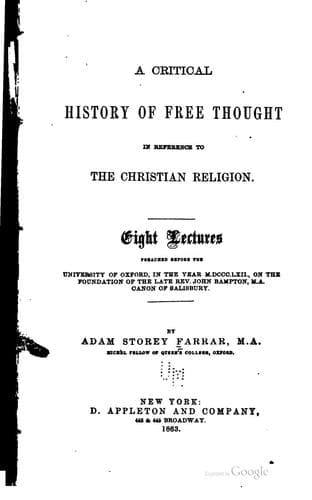
History of Free Thought in Reference to The Christian ReligionFarrar, Adam Storey
History
History of Free Thought in Reference to The Christian Religion
Farrar, Adam Storey
Free thought -- History
When, for example, Christian doctrine has been overlaid from age to age by
concretions which had gathered round it, as was the case previously to the
Reformation,(1018) it has been free thought which has attacked the system,
and, piercing the error, has removed those elements which had been
superadded. Or, when the church has attempted to fetter human thought in
other departments than its own proper domain of religion, as when the
ecclesiastical authorities disgraced themselves by vetoing the discoveries
of Galileo,(1019) it has been to free thought that we owe the emancipation
of the human mind. Or, when the church linked itself in alliance with a
decaying political system, as in the last century in France, it was free
thought that recalled to it the lesson to render to Cæsar the things that
were Cæsar’s, and to God the things that were God’s. It is instances like
these, where free thought has been the means of making undoubted
contributions to human improvement, or of asserting toleration, which have
led writers to describe it as almost innocuous, and hastily to regard the
ratio of the emancipation of the human mind from the teaching of the
priesthood to be the sole measure of human improvement.
In many instances also, free thought has indirectly contributed to
intellectual good, in points where it has ran a greater risk, than in
those just cited, of trespassing upon the sacred truths of religion;
instances, in fact, where the benefit resulting has been owing to the
overruling Providence which brings good out of evil, rather than to any
direct intention on the part of those who have exercised it. Examples are
to be found in those epochs, when some sudden outburst of knowledge
compelled a reconsideration of old truths by the light of new discoveries.
The awakening of the mind in the middle age, the Renaissance, the advance
of modern science, the birth of literary criticism, are instances of such
moments, wherein free inquiry has been a necessity forced on the mind by
outward circumstances, not self-prompted. This attitude of inquiry, this
exercise of a provisional doubt, was not, like that described, called
forth merely by the circumstance that religion had received additions from
error, but must have arisen even if the faith once delivered had been
preserved uncorrupted. For religion being a fixed truth, while truth in
other departments is progressive, it would have been impossible to avoid
the necessity of comparison of it with them from time to time, in those
spheres where it intersected the field occupied by them.
Public-domain text, read in full here on John Shaqi.
Reviews
Reviews
No reviews yet
Be the first to share your thoughts on this work.
Elsewhere in the archive
Join the Discussion
Join the discussion
Sign in to leave a comment or review.
Sign InorCreate an account