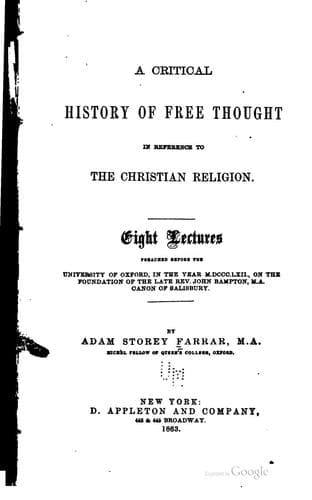
History of Free Thought in Reference to The Christian ReligionFarrar, Adam Storey
History
History of Free Thought in Reference to The Christian Religion
Farrar, Adam Storey
Free thought -- History
But the heart asks a further moral. Though it derives satisfaction from
perceiving that even features of history which seem the darkest, and
moments the most perilous, bear witness to the presence of a benevolent
Creator, who overrules all for the improvement of man and the progress of
the church; it still claims to know what those limits are, where doubt
must expire in awe, and speculation in adoration. It longs to exercise
inquiry, and yet retain the Christian faith. It asks earnestly what does
the history teach us concerning the doubts that are most likely to meet us
in our lifetime, and what lessons are supplied by it in reference to the
best mode at once of maintaining our own faith, and of leading those who
doubt to the faith which we receive. The materials are supplied for an
answer to these questions; probably even the materials for the final
answer which the church can give to them.
We venture not to utter predictions in reference to the future; but the
thought is interesting and solemn, that there seems some reason to believe
that the weapons which doubt on the one hand, and religion on the other,
must use in the final adjudication of their claims, at least in reference
to all fundamental questions, are already in men’s hands. Though our
express denial that doubt perpetually recurs in cycles might cause it to
be supposed that we should be inclined to anticipate the existence of
future crises of faith; yet we have remarked that such crises are always
produced by the opening of some unexplored field of knowledge, the
introduction of a collection of new ideas or of a new spirit excited by
new ideas, on subjects traversed either by the Christian religion, or by
the Christian inspired books. A survey of the present state of knowledge
would probably lead us to think that no field lies unexamined from which
such new material can hereafter come. The physical sciences which, by the
discovery of an order of nature and general laws of causation, have
heretofore suggested difficulties in reference to miraculous
interposition, and, by means of the discoveries in astronomy and geology,
have come into conflict with the ancient Hebrew cosmogony, are not likely
to suggest fresh ones distinct in kind from the past. If there be not
ground for discouragement in science, nor for doubting that the present
state of it, which seems to offer employment for originality of mind
rather in tracking old principles into details than in ascending to new
ones,(1022) is merely a temporary one, destined to pass away when some
happy guess shall reveal the highest laws which now baffle inquiry; yet it
is not probable that such an advance will traverse the province of
religion. The survey of those regions where discovery seems most hopeful,
will explain the reason of this assumption.
Public-domain text, read in full here on John Shaqi.
Reviews
Reviews
No reviews yet
Be the first to share your thoughts on this work.
Elsewhere in the archive
Join the Discussion
Join the discussion
Sign in to leave a comment or review.
Sign InorCreate an account