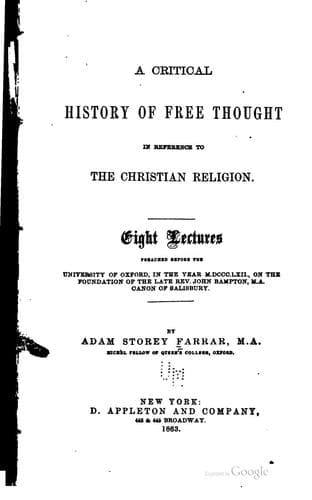
History of Free Thought in Reference to The Christian ReligionFarrar, Adam Storey
History
History of Free Thought in Reference to The Christian Religion
Farrar, Adam Storey
Free thought -- History
The value of the free inquiry in this latter class of cases is not in the
process, but in the results; in producing the branch of theology which
sets forth the evidences of revealed truth. We have previously had
occasion to imply that the Christian evidences are too often regarded as
mere weapons of defence; like the battle-fields of history, monuments of
the struggle of evil. Being a form of truth which would never have been
called forth if the church had not been attacked, the apologetic
literature is usually regarded, either as obsolete because controversial,
or as useless for believers. Yet truths brought to light by it, though
dearly purchased, are a real contribution to Christian knowledge. As
miracles are a part of Christianity as well as an evidence, so apologetic
literature, while useful in argument, serves the purpose of instruction as
well as of defence.(1021) The controversy with heresy or unbelief has
caused truths to be perceived explicitly, which otherwise would have been
only implicit; and has illustrated features of the Christian doctrine
which might otherwise have remained hidden. Though these good results have
not been designed by unbelievers, and cannot therefore warrant the claim
asserted for scepticism, that it is always innocuous, nor be set down to
the credit of free thought as a spirit; yet they evidence the value of it
as a method; the free thought, that is, which is inquiry and
consideration, not that which is disbelief.
While therefore fully appreciating the reverent wish of Christian men to
defend the truth with sacred tenacity, which leads them to regard all
doubt with alarm; we can frankly allow the function and use of the
phenomenon of doubt in history, when viewed as an intellectual fact. The
use of it is to test all beliefs, with the view of bringing out their
truth and error. But the good result has often, we perceive, been
undesigned. It has frequently too been dearly bought, attained at an
incalculable spiritual loss to the souls of those who have doubted. The
result accordingly leaves untouched the responsibility of the doubter, and
only shows the use which an allwise Providence makes free thought subserve
in the general progress of the world.
Public-domain text, read in full here on John Shaqi.
Reviews
Reviews
No reviews yet
Be the first to share your thoughts on this work.
Elsewhere in the archive
Join the Discussion
Join the discussion
Sign in to leave a comment or review.
Sign InorCreate an account