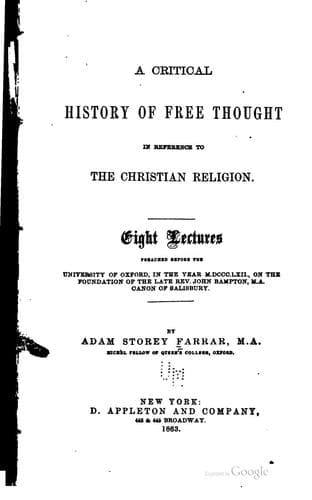
History of Free Thought in Reference to The Christian ReligionFarrar, Adam Storey
History
History of Free Thought in Reference to The Christian Religion
Farrar, Adam Storey
Free thought -- History
The instances however are rare, where we meet with a chaos of faith, half
pantheism, half atheism, such as that which we have just described. The
great majority of doubters are persons who not only retain a tenacious
grasp over monotheism, but even possess a love for Christianity. Their
love is however for a modified form of it, different from that which the
apostles taught. They cordially believe that God cares for man, and that
He has spoken to man through His Son. They accept the superhuman, perhaps
the divine, character of Christ; but they consider his life to be a mere
example of unrivalled teaching, and of marvellous self-sacrifice; his
death the mere martyrdom that formed the crowning act of majestic
self-devotion. God’s gift of His son is accordingly, in their view, to
reconcile man to God; to remove the obstacle of distrust which prevented
man from coming to God, by showing forth the love which God already bore
to the world; not to remove obstacles, known or unknown, which prevented
God from showing mercy to man. Christ is accepted as a teacher, and as a
king, but not as a priest. His work is viewed as having for its purpose,
to inculcate and embody a higher type of morality, not to work out a
scheme of redemption. The ethical element of Christianity becomes elevated
above the dogmatic. The sermon on the mount is regarded as the very soul
of Christ’s teaching. And in looking forward to the future of
Christianity, the Christian religion is considered likely to become the
religion of the world, merely because it will have ceased to be the
religion of form and dogma, and become the highest type of ethics.
Views like these are common, and their compatibility with Christianity is
defended in different ways:—sometimes by the bold attempt, as in the
speculations of the Tübingen school, to prove that primitive Christianity
was such a religion as that just described; that the dogmatic Christianity
of the early fathers was the addition made by philosophy to the first
doctrine, the _idola theatri_, which haunted the minds of the early
teachers; and that the books of the New Testament, to which we appeal to
prove the contrary, belong to a later date than that usually
assigned:—sometimes, with less consistency, admitting the antiquity of the
dogmas, by representing that we can penetrate into the philosophy of the
apostolic doctrine, and express in modern phrase, more clearly than in the
ancient, the meaning which was intended to be conveyed:—at other times, by
regarding all truth as relative to its age, and supposing that Christ’s
work was seen by the light of the sacrificial and Messianic ideas common
in the apostolic times.
Public-domain text, read in full here on John Shaqi.
Reviews
Reviews
No reviews yet
Be the first to share your thoughts on this work.
Elsewhere in the archive
Join the Discussion
Join the discussion
Sign in to leave a comment or review.
Sign InorCreate an account