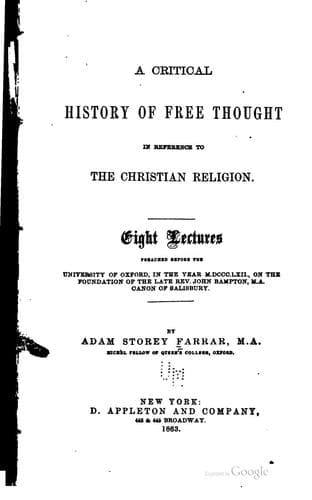
History of Free Thought in Reference to The Christian ReligionFarrar, Adam Storey
History
History of Free Thought in Reference to The Christian Religion
Farrar, Adam Storey
Free thought -- History
Connected with this fundamental disagreement with the ordinary teaching of
the Christian church, on the central question of Christ’s work and the
nature of Christianity, is the cognate question concerning the relation of
the Bible as a rule of faith. Its superiority to ordinary books is
admitted, as cordially as the superiority of Christ’s work to that of
ordinary beings; but the religious contents of it, not to speak of the
literary, are criticised, not indeed in a polemical, but in an independent
spirit; and are measured in the manner just described, and approved or
rejected in accordance with it.
Thus these two questions,—the atoning work of Christ, and the authority of
the scriptures,—are the two forms of doubt which are most likely to meet
us in the present age.
The expression of them in the clergy of any particular church may of
course, if it be deemed necessary, be prevented by political means. A
church, if regarded merely in a worldly point of view, is a political as
well as a spiritual institution, where the members cede somewhat of
individual freedom for the good of the whole; a compact where certain
privileges and remunerations are granted, in return for the communication
of certain kinds of instruction, and the performance of certain offices:
and no one can object that the terms of a treaty be maintained; but the
prevention of the expression of doubt is not the extinction of the
feeling. And such acts of repression cannot reach the laity of the church,
even if they touch the clergy. The inquiry accordingly here intended, as
to the means for repressing such doubts, does not descend to the political
question, but is a spiritual one; viz. if these doctrines are contrary to
Christ, how can such thinkers be directed by moral means to the truth
which we believe? or what reason can we give for the hope that is in us,
which leads us to decline yielding up one iota of dogmatic Christianity to
them?
The history of evidences offers a series of experiments, in which we may
find an answer to these questions, by studying the different methods
adopted in various centuries for spreading Christianity.
Public-domain text, read in full here on John Shaqi.
Reviews
Reviews
No reviews yet
Be the first to share your thoughts on this work.
Elsewhere in the archive
Join the Discussion
Join the discussion
Sign in to leave a comment or review.
Sign InorCreate an account