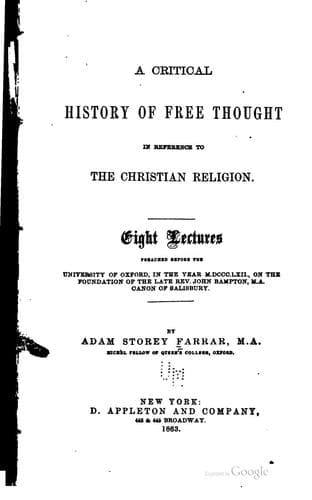
History of Free Thought in Reference to The Christian ReligionFarrar, Adam Storey
History
History of Free Thought in Reference to The Christian Religion
Farrar, Adam Storey
Free thought -- History
In the German period the same method has been adopted, with the
corresponding alterations suggested by modern philosophy. Not to mention
the instructive attempts of the school of Kant to find a philosophy from
the subjective side of religion, in the denial of its possibility if
attempted on the objective, and to exhibit the limitations of the human
mind in speculating on the subject of religious method; nor again to
mention the bold attempt of Hegel, to which we have previously taken
exception as opposing the simplicity that is in Christ, to work out this
forbidden problem, and find a philosophy for Christianity on the objective
side: we allude to that which has marked the disciples of Schleiermacher
to find it on the subjective as a life, and fact, and doctrine, which
fulfils the yearnings of the individual heart.
In pursuing a method of this kind, the appeal must be made to the
inextinguishable feeling of guilt; to our personal consciousness of a
personal judge; our terror at the sense of justice; our penitence for our
own ill deserts; the deep consciousness of the load of sin as an
insupportable burden from which we cannot rescue ourselves; and to the
guilt of it which separates between us and God, as a bitter memory that we
are powerless to wipe away.(1037) When these facts are not only
established as psychological realities, but appropriated as personal
convictions, then the way is prepared for the reception of Christianity.
The heart, by realising the personality of God, is at once elevated above
naturalism or pantheism. It feels that in Christ’s incarnation it finds
God near, the infinite become finite, God linked to the heart of a man;
and in his atonement it finds God merciful. Its deep instinct leads it to
reject the theories which would pare down the marvel of that mystery. Its
consciousness of guilt tells it of an obstacle which it cannot believe to
lie merely in itself, but attributes to the mind of the infinite Spirit
which it wants a method for removing. No mere example of majestic
self-sacrifice proclaiming God’s love to man suffices to solace its
sorrows. Some mighty process, wrought out between the Son and the almighty
Father, is instinctively felt to be necessary, as the means by which God
can be just and yet the justifier of the sinful. And when philosophy has
thus prepared the heart by its appeal to the yearnings of the soul, and
brought it to long for the very remedy which Christianity supplies; then
the historic argument can be properly introduced, to afford the solid
comforting assurance that the remedy wanted has really been given; that
miracles and prophecy are divine evidences, attesting the truth of the
claim that certain teachers at a particular period received superhuman aid
to reveal certain religious truths. (49)
Public-domain text, read in full here on John Shaqi.
Reviews
Reviews
No reviews yet
Be the first to share your thoughts on this work.
Elsewhere in the archive
Join the Discussion
Join the discussion
Sign in to leave a comment or review.
Sign InorCreate an account