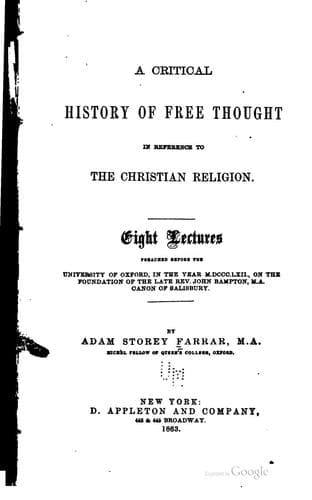
History of Free Thought in Reference to The Christian ReligionFarrar, Adam Storey
History
History of Free Thought in Reference to The Christian Religion
Farrar, Adam Storey
Free thought -- History
The two periods in church history among those here named, which offer most
instruction to us in consequence of affording examples of the same class
of difficulties as those which we encounter, are, the struggle in the
early centuries, and that in Germany during the present. The line of
argument which was used in the former of these crises is seen in the
Alexandrian school of the fathers in the third century, and that used in
the latter, in the school of Schleiermacher. The study of the life and
mental development of Schleiermacher’s disciple, Neander, would be in this
view one of the most valuable in history.(1032) He was himself led by the
mercy and providence of God to the knowledge of Christ; his own spirit was
rescued from doubts such as we describe; his life was spent in trying to
save others from the like difficulties, and to plant their feet upon the
rock upon which he himself stood: and it is only the secrets of the great
day that will declare the number of the souls that were led by his
teaching to find Christ and salvation.
In both these periods the method adopted for recommending Christianity
was, to carry out the plan used by St. Paul at Athens,(1033) to lay a
basis for the proof of it by developing the moral and philosophical
argument.
In the Alexandrian period the method used was, to show that all former
religions, all former philosophies, were not unmixed error, but contained
the germ of truth, which Christianity gathered into itself; to exhibit
Christianity as the fulfilment in the field of history of the world’s
yearnings, and thus to awaken the response of the heart to the narrative
of its message.(1034) Reasons, to which allusion has before been
made,(1035) may have lessened the utility at that period of the positive
evidence, which proves the fact that a Redeemer had been given; but we
cannot doubt that, independently of this circumstance, a deep
philosophical reason suggested the stress which was laid on the moral
argument, on account of its suitability for convincing the opponent;—a
reason indeed to which the history of some of the fathers gave a personal
force in the fact that it was by this manner that they had themselves been
led to accept of Christianity.(1036)
Public-domain text, read in full here on John Shaqi.
Reviews
Reviews
No reviews yet
Be the first to share your thoughts on this work.
Elsewhere in the archive
Join the Discussion
Join the discussion
Sign in to leave a comment or review.
Sign InorCreate an account