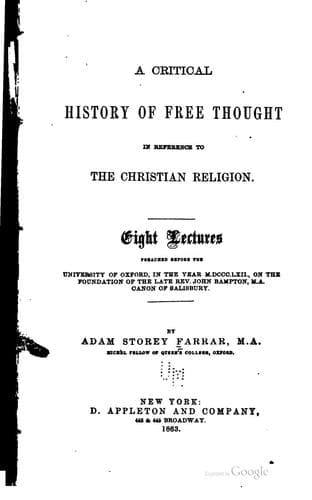
History of Free Thought in Reference to The Christian ReligionFarrar, Adam Storey
History
History of Free Thought in Reference to The Christian Religion
Farrar, Adam Storey
Free thought -- History
Let us, for example, suppose that we have come to the conclusion, that the
apostles taught the doctrine of the atonement; and that our moral sense is
puzzled with the justice of the system, of the transfer of merit implied
in those analogies under which the mysterious verity is unveiled to us,
and with its apparent incompatibility with a corrective theory of
punishment: the thought of error, or of merely relative truth, in the
apostles’ teaching in such a matter, is forbidden to the mind of any one
who admits the least divine inspiration in them, from the fact that this
is the innermost and most sacred truth of their creed. We could imagine
the early teachers left unaided in all matters irrelevant to religion;
nay, by a stretch of supposition, possibly even in some unimportant things
appertaining to religion itself: but a mistake on the work and office of
Christ,—the very point which, of all others, they were commissioned to
teach;—an ingredient of error insinuating itself here, is utterly
improbable. If even the inspired authority were denied, the improbability
would be hardly less apparent. For this was not a doctrine of the head,
but of the feelings; not a fact coldly believed, but appropriated; the
voice of the inmost consciousness. If the story of the apostles be true,
that the belief of this doctrine, and the prayers founded upon it, had
made them changed men; if too their history testifies to the reality of
their professions of extraordinary holiness; we could not, even if we did
not know from their writings that they were men who were accustomed to the
careful analysis of their own feelings, conceive a fatal falsehood to lurk
here, in a point where the mixture of inference with consciousness must
have been reduced to a minimum.
In this particular case of the atonement, there is however an independent
proof of the correctness of the apostles’ teaching, through the
corroboration of it which is offered by the Christian consciousness of the
church. We have before had occasion(1046) to explain the introduction of
this idea in the teaching of Schleiermacher, and to protest against the
use which he proposed to make of it as a source of truth, independently of
the Christian consciousness of the apostles and first teachers; as the
gradual source of doctrinal progress, the oracular utterance to this age,
as the apostolic consciousness was to the first age.
Public-domain text, read in full here on John Shaqi.
Reviews
Reviews
No reviews yet
Be the first to share your thoughts on this work.
Elsewhere in the archive
Join the Discussion
Join the discussion
Sign in to leave a comment or review.
Sign InorCreate an account