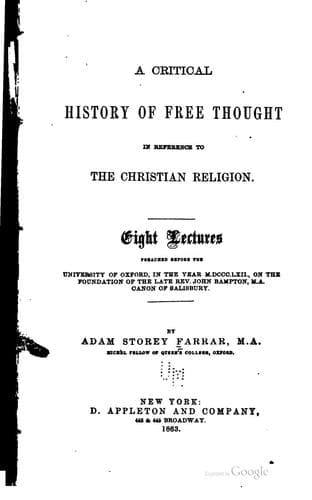
History of Free Thought in Reference to The Christian ReligionFarrar, Adam Storey
History
History of Free Thought in Reference to The Christian Religion
Farrar, Adam Storey
Free thought -- History
But there is a deep truth in it, if we use the Christian consciousness,
not to supersede scripture, but as the living corroboration and
interpreter of it. The Spirit of God still works on the hearts of men
morally, as upon the apostles of old; not by conferring the intellectual
gift of inspiration, but in the moral gifts of penitence, of conversion,
of pardon, of holiness. Holy men now feel the Spirit of God striving with
them as the apostles did, and appropriate the excellence of Christianity,
and feel its renovating power now as then. Therefore the attestation of
these men, such as is collected by an induction founded on their
biographies, to the fact that when they analyse their secret feelings with
the most exact care, they recognise that the pardon which they receive is
through the mercy of Christ; that their moments of most hallowed communion
with the Father-spirit are when they approach the throne of mercy through
the mediation and intercession of another, Christ Jesus; that the victory
vouchsafed to them over temptation, is by His merits; that their heart
finds no Father for one moment except through him;—this evidence, if it
can be accepted, is an independent corroboration of dogmatic truth. It may
be explained away, by denying the truth of their analysis, or by referring
their feeling to mental association; but it cannot fail to have a
persuasive force for those who have faith in the instinctive utterances of
the human soul: and the reliance upon it is not more extraordinary than
that on which we depend in cognate subjects like æsthetics, where the
taste of practical skill is trusted. Christian consciousness thus becomes
a new source of facts in theological study; the living voice of the church
for illustrating and confirming in some degree the utterance of men of
old, who spake that which was revealed to their souls by the inspiring
Spirit.
Such are the chief steps which the history of evidences, in the contest
with early heathenism, as well as in the recent struggle in Germany, seems
to point out as the most likely to lead a doubter to Christ; and such the
order in which the philosophical and historical evidences ought to be
respectively presented, if our object be to give due heed to the desire
which an inquirer evinces to appropriate the truth which he believes. Such
too, if the opinion already advanced concerning the future of modern doubt
be correct, seems to be the final answer which the church can give.
Without undue compromise, commencing with the internal evidence, we thus
lead men to the external, and make philosophy as it were the schoolmaster
to lead to Christ.
The third question of those which we enumerated as likely to press upon
us, viz. that which refers to the inspiration of the scriptures, requires
only a few words; inasmuch as the treatment of it has already, to some
extent, been implied.
Public-domain text, read in full here on John Shaqi.
Reviews
Reviews
No reviews yet
Be the first to share your thoughts on this work.
Elsewhere in the archive
Join the Discussion
Join the discussion
Sign in to leave a comment or review.
Sign InorCreate an account