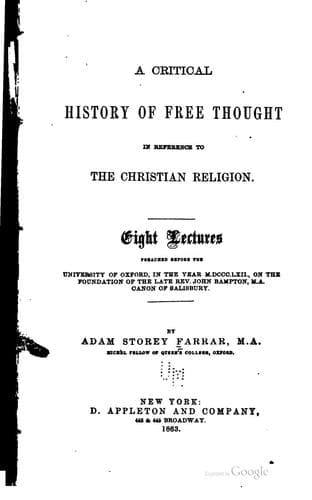
History of Free Thought in Reference to The Christian ReligionFarrar, Adam Storey
History
History of Free Thought in Reference to The Christian Religion
Farrar, Adam Storey
Free thought -- History
This question has been elevated, since the Reformation, to an importance
which it hardly possessed before. Since the authority of the Bible has
been substituted for the authority of the church, it has been usual to
regard the scriptures as the mode of leading men to Christ, instead of
considering the knowledge of Christ received through the ministrations of
the church as the clue to interpret scripture. Logically, the scripture is
the rule of faith, the ground of the church’s teaching; but
chronologically, the teaching of the church is the means of our knowing
the scripture.(1047)
A caution hence arises, that we should not be willing to allow preliminary
difficulties, which a doubter may have in reference to the scriptures, to
deter us from leading him straight to Christ, and then allowing him by the
light of this teaching to reconsider the question of the scripture. The
difficulties will generally be found to have reference to the historical
and literary portions, rather than the doctrinal, or those portions of the
literature which contain the doctrinal. If indeed they refer to the
doctrinal, they must be answered at the outset in the manner already
shown. If however to the literary, they will be viewed in a different
light, if the doubter has been brought to appreciate the central truths of
Christianity, from that which they will bear if wrangled out on the
threshold of his approach. In the last century indeed, the comparative
importance of the doctrinal parts of scripture over the literary was so
perceived, when doubts were pressed on the attention of the clergy by the
pertinacity of the deist controversialists, that many of the eminent
writers restricted the plenary inspiration of the scripture writers to the
appropriate matter of the revelation, the supernatural communication of
the miraculous system of redemption; and conceived that it was no
derogation from the supreme religious authority of the sacred writers, but
rather compatible with the loftiest idea of the providential adaptation of
means to ends, to suppose them unassisted in literary matters, such as the
transcription of genealogies, the reference to natural phenomena, or the
literal exactitude of quotations. The jewel of divine truth did not, in
their opinion, sparkle less brilliantly because it was handed down in a
frame of antique setting. (50) In the present day there is a strong
reaction in religious minds in favour of the opposite view, identical with
the one held in the seventeenth century by the Puritans. The reaction is
only a special instance of the general movement in favour of authority,
political and ecclesiastical, which has taken a sudden advance throughout
the religious part of Europe, in opposition to the subjective tendency
already noticed in secular literature.(1048) This special view however is
dictated by a noble motive, a watchful fear lest the loss of a single atom
may weaken the whole structure. Whether it be true or not is not at
Public-domain text, read in full here on John Shaqi.
Reviews
Reviews
No reviews yet
Be the first to share your thoughts on this work.
Elsewhere in the archive
Join the Discussion
Join the discussion
Sign in to leave a comment or review.
Sign InorCreate an account