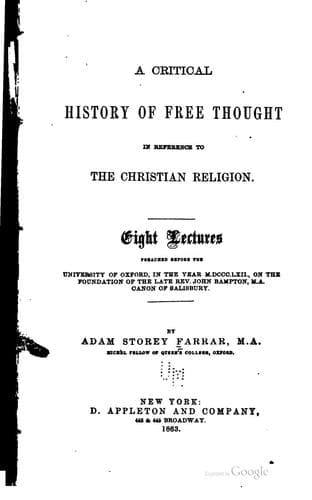
History of Free Thought in Reference to The Christian ReligionFarrar, Adam Storey
History
History of Free Thought in Reference to The Christian Religion
Farrar, Adam Storey
Free thought -- History
Let us strive to use the two methods of finding truth,—study and prayer.
Let us gain more knowledge, and consecrate it to the investigation of the
highest problems of life and of religion; especially applying ourselves,
by the help of the ripest aid which miscellaneous literature or church
history can afford us, to the study of the sacred scriptures. But above
all these intellectual instruments, let us add the further one of prayer.
For prayer not only has a reflex value on ourselves, purifying our hearts,
dispersing our prejudices, hushing our troubled spirits into peace; but it
acts really, though mysteriously, on God. It ascends far away from earth
to the spot where He has His dwelling-place. The infinite God condescends
to enter into communion with our spirits, as really as a man that talketh
with a friend. The Saviour of pity will Himself look down upon us, and
condescend to become our teacher, and give us the purity of heart which
will lead us into truth. Our own trials, our own struggles for truth and
holiness, the desire to know Christ and to be known by Him, will excite
our deep pity for those who endure the like temptations, and prepare us
for effectually ministering to the good of others. And if the struggle in
our own hearts be long, and there be moments when we seem to have our
Gethsemane; let us cleave the closer, with the more simple trust, to our
heavenly Father; still imploring Him to grant us in this world knowledge
of his truth, and in the world to come life everlasting; assured that the
clouds shall one day disperse, and the vision of truth be unveiled to us
in the bright light of the eternal morning.
I shall be well content that all that I have said to you be forgotten; and
when these lectures take their humble place in the series of which they
form a part, deriving an honour, not their own, from the great names with
which they are associated, I shall be willing that they be consigned to
neglect; if I can only hope that this final exhortation to prayerful study
may remain fixed in the memory of any one of those that now hear these
words, or may impress the mind of any chance student who, in traversing
the same ground, may hereafter have occasion to peruse them, at a time
perhaps when the voice that now speaks shall be hushed in the tomb, and
the spirit shall have gone to its account.
-------------------------------------
The lectures are now ended. May God forgive the errors, and sanctify any
truth that has been uttered to His honour! The faults are mine: the truth
is His, not mine. To Him be the glory.
NOTES.
Lecture I.
Note 1. p. 3. Subdivisions Of Historical Inquiry.
A few words may explain the distinctions intended in the text.
Public-domain text, read in full here on John Shaqi.
Reviews
Reviews
No reviews yet
Be the first to share your thoughts on this work.
Elsewhere in the archive
Join the Discussion
Join the discussion
Sign in to leave a comment or review.
Sign InorCreate an account