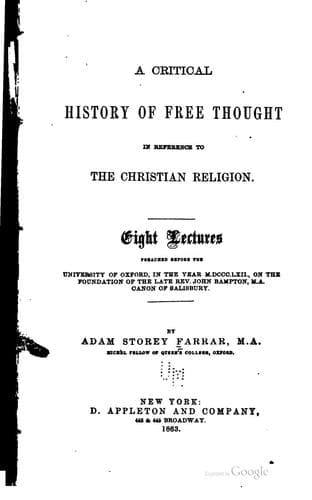
History of Free Thought in Reference to The Christian ReligionFarrar, Adam Storey
History
History of Free Thought in Reference to The Christian Religion
Farrar, Adam Storey
Free thought -- History
History has been properly distinguished by Macaulay into two branches, the
artistic or descriptive, and the scientific or analytic. (_Essays_, vol.
i. 2, on Hallam.) If viewed in the former aspect, history aims as far as
possible to reproduce what has been, to recover a picture of the past.
Hence it is obedient to the two conditions which rule all art,—precise
outline in details, and preservation of perspective in the combination. In
the latter, theory in some slight degree steps in, but theory dictated by
the instinct of taste rather than by reflection. It is in this branch, in
which the historian is the critic, that the border line lies between art
and science. For it is hard to measure the precise amount which is due in
the appreciation of facts respectively to artistic intuition and to
reflective analysis.(1054)
Supposing the facts to be thus given, it is the province of the science of
history to ascertain their causes. Two living writers, Mr. Mill (_System
of Logic_), and Dr. Whewell (_Philosophy of Inductive Sciences_), have
given an account of the logic of science. That of the latter is more
suitable to the conception which we are here forming of history; for
history is exactly one of the class of sciences which he calls
“Palætiological.” (vol. i. b. x.) It requires first, that we recover the
record of the successive stages of facts, the narrative of the past,
before searching for the causes. The causes are then to be sought by
transferring backward for the explanation of the past those which are at
present operating. The search will probably exhibit three successive
stages in the process of examination. First, causes will be found which
are the mere antecedents of the events, the mere links which connect the
phenomena. Next, a cyclical law of the recurrence of the facts is
perceived, such e.g. as Vico’s well-known law concerning the development
of political society. Such a law as this, supposing it to hold good
without exception within the limits of experience, is what Mr. Mill calls
an “empirical law.” (_Logic_, vol. ii. b. iii. ch. xvi.) Next, this law
must be analysed into its causes. Mr. Mill gives three forms which this
third stage of analysis may assume in science. (_Id._ vol. i. b. iii. ch.
xii.) Probably in history it will generally assume the one of the three in
which the complex result is analysed into its simpler component elements.
(_Id._ § 2.)
Public-domain text, read in full here on John Shaqi.
Reviews
Reviews
No reviews yet
Be the first to share your thoughts on this work.
Elsewhere in the archive
Join the Discussion
Join the discussion
Sign in to leave a comment or review.
Sign InorCreate an account