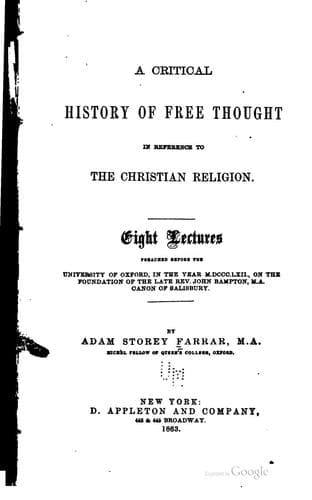
History of Free Thought in Reference to The Christian ReligionFarrar, Adam Storey
History
History of Free Thought in Reference to The Christian Religion
Farrar, Adam Storey
Free thought -- History
The contest of Christianity with Mahometanism, so far as it has been a
struggle of argument and not of the sword, offers few remarkable points.
In the first sweep of the Mahometan conquest, when the Christian nations
succumbed both in the east and west, there was no field for a question of
truth. It was only in Christian nations which were removed from peril, and
yet sufficiently in contact to entertain the question of the claims of the
Mahometan religion, that a consideration of its nature, regarded as a
system of doctrine, could arise. Accordingly it is in Constantinople, or
in Spain and the other parts of western Europe which came into connexion
with the Moors, that works of this character appear.
The history may be conveniently arranged in three periods, each of which
is marked by works of defence, some called forth by danger, a real demand,
but subsiding into or connected with inquiries prompted only by literary
tastes. The first is from the twelfth to the middle of the sixteenth
century; the second during the seventeenth and eighteenth; the third
during the present century.
1. A notice of the Mahometan religion exists in a work of J. Damascenus,
in the eighth century; and Euthymius Zigabenus, a Byzantine writer of the
twelfth: but the first important treatise written directly against it was
in 1210, _Richardi Confutatio_, edited in 1543 by Bibliander from a Greek
copy. The refutation of Averroes by Aquinas, about 1250, can hardly be
quoted as an instance of a work against the Mahometan religion, being
rather against its philosophy. A treatise exists by John Cantacuzene,
written a little after 1350; which is to be explained probably by the
circumstance that the danger from Mahometan powers in the east directed
the attention of a literary man to the religion and institutions which
they professed. Thus far the works were called forth by a real demand.
A series of treatises however commences about the time of the expulsion of
the Moors from Spain, the cause of the existence of which is not so easy
of explanation. Such are those in Spain by Alphonso de Spina, 1487, and by
Turrecremata (see Eichhorn’s _Gesch. der Lit._ vi.); by Nicholas de Cuza,
published in 1543; in Italy about 1500 by Ludovicus Vives, and
Volterranus; one by Philip Melancthon in reference to the reading of the
Koran; and a collection of treatises, including those of Richardus,
Cantacuzene, Vives, and Melancthon, published by Bibliander in 1543.
Probably the first two of this list may have been the relic of the crusade
of Christianity against the Moorish religion; the next two possibly were
called forth by the interest excited in reference to Mahometans by reason
of their conquests, or less probably by the influence of their philosophy
at Padua (see Lect. III. p. 100 seq.). The two last are hardly to be
explained, except by supposing them to be an offshoot of the Renaissance,
and called forth by the largeness of literary taste and inquiry excited by
that event.
Public-domain text, read in full here on John Shaqi.
Reviews
Reviews
No reviews yet
Be the first to share your thoughts on this work.
Elsewhere in the archive
Join the Discussion
Join the discussion
Sign in to leave a comment or review.
Sign InorCreate an account