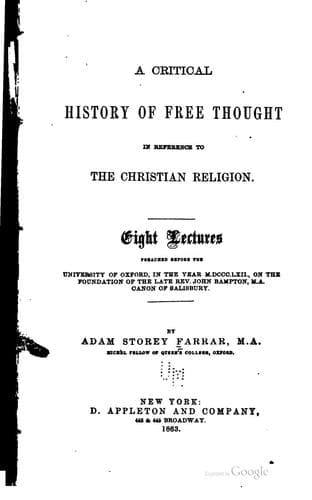
History of Free Thought in Reference to The Christian ReligionFarrar, Adam Storey
History
History of Free Thought in Reference to The Christian Religion
Farrar, Adam Storey
Free thought -- History
3. In the third phase of the controversy, viz. that which exists with the
modern Jew, the controversy is a little changed. The old prejudices
against Christianity are in a great degree made obsolete by the freedom of
commercial intercourse, and the enjoyment of protection and civil liberty;
and hence the contest takes two forms; either the continuation of the
argument concerning the meaning of Jewish prophecy, or a discussion on the
function of the Jewish religion in history. Sources for the former are
found in the older books of evidence. A digest of the arguments concerning
it is given in J. Fabricius (not the celebrated Fabricius), _Consideratio
Variarum Controversiarum_, 1704, p. 41, and in Stapfer’s _Institut.
Theolog. Polemic_, vol. iii. 1-288, 1752; or in the modern works, Greville
Ewing’s _Essays addressed to the Jews_, and Dr. McCaul’s _Old Paths_,
1837, and his _Warburton Lectures_, 1846. The condition of Jewish life and
thought may he seen in Allen’s _Modern Judaism_. The system of
interpretation on which the controversy is conducted is either the ancient
Messianic and allegorical of the Targums and Talmud, or the literal and
grammatical introduced by the Spanish mediæval commentators.(1058)
The other form of Jewish argument which Christians have to encounter is
more novel, and, being confined to educated Jews, its influence is less
wide, and does not actuate the stratum of Jewish life with which
missionaries generally come into contact. It is based on modern
rationalist speculations, and is seen in a work of Dr. Philippsohn, late
rabbin at Magdeburg, _Development of the Religious Idea in Judaism,
Christianity, and Mahometanism_, (translated both into English 1855, and
also into French,) and in the writings of Salvador. Dr. Philippsohn
regards the mission of Judaism to be, from first to last, to teach to the
world the lesson of monotheism. He traces the struggle in the Jewish
church between priestism and prophetism; and regards Christianity as an
abnormal form of the latter, which has led the world away to Tritheism:
and, so far from regarding the office of Judaism to be extinct, he
considers that its mission is still to restore monotheism to the world. A
comparison with the statement of the views of the Tübingen school in Lect.
VII. or the speculations of Mr. Mackay in Lect. VIII. will show how
completely this argument is borrowed from the later forms of German
historical criticism.
The views of Salvador in France (see p. 299) are too original to be
regarded as typical of the views of a party. They reproduce the critical
difficulties of Maimonides and Spinoza, which seem never to have found
favour with the Jews; but the general similarity of the doctrinal part of
Salvador’s system to that just described is very observable.
Note 5. p. 12. The Contest Of Christianity With Mahometanism.
Public-domain text, read in full here on John Shaqi.
Reviews
Reviews
No reviews yet
Be the first to share your thoughts on this work.
Elsewhere in the archive
Join the Discussion
Join the discussion
Sign in to leave a comment or review.
Sign InorCreate an account